

When ordering TOCO linear guides, one of the most important technical specifications you'll encounter is the Preload Class (typically labeled as ZF, Z0, Z1, or Z2).
Many designers mistakenly equate high preload with high quality, but in reality, preload is a tool that must be used precisely to balance accuracy against longevity.
What is Preload?
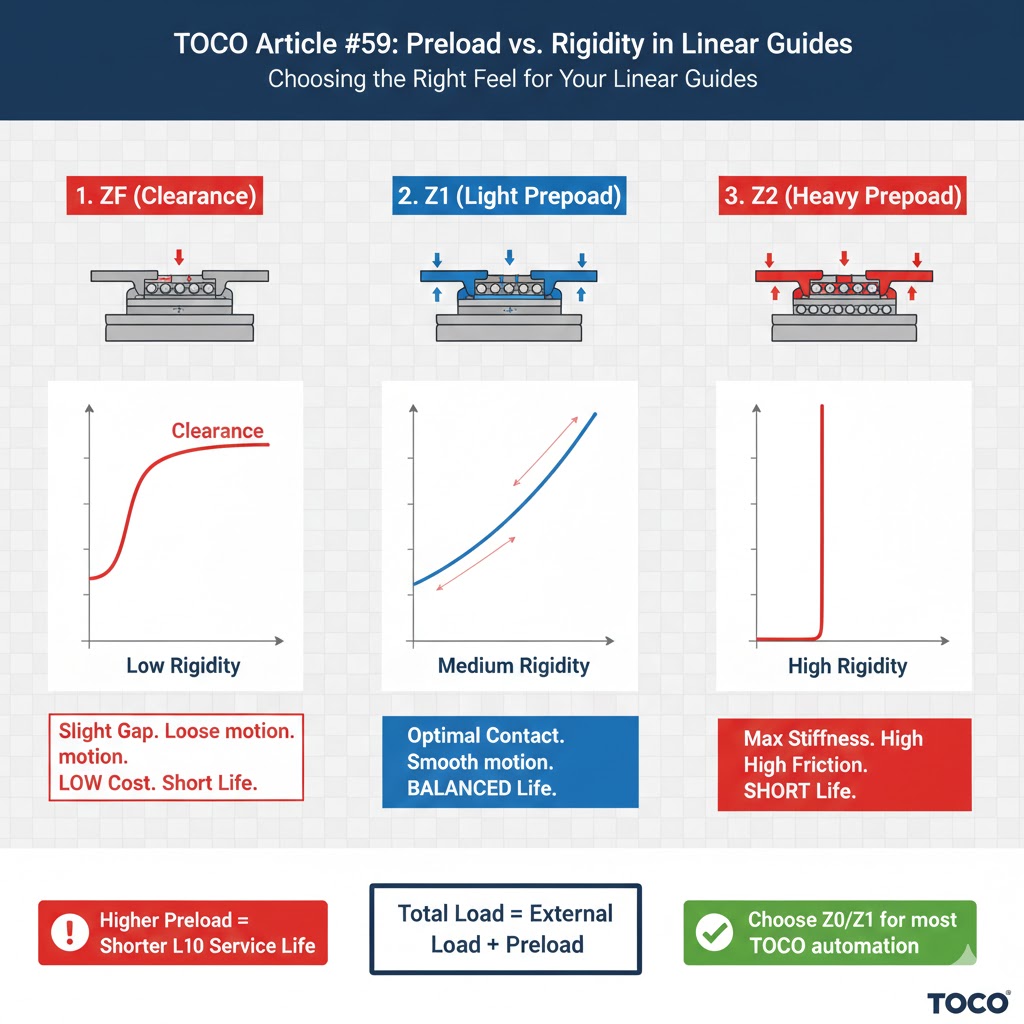
Preload is the process of using oversized rolling elements (balls or rollers) to eliminate internal clearance between the carriage and the rail. This creates a "negative clearance," ensuring that the rolling elements are already under a slight compressive load before any external force is applied.
The Trade-Off: Rigidity vs. Friction
The primary reason to use a higher preload is to increase Rigidity.
High Rigidity: Under heavy loads or high-speed changes, a preloaded carriage will deflect less. This is essential for CNC milling or high-precision inspection where microns matter.
The Friction Penalty: Higher preload increases the "Rolling Resistance." This requires more motor torque to move the carriage and generates more internal heat.
How Preload Affects Service Life
This is where many engineers get caught off guard. Preload acts as a "Constant Load" on the bearings. When calculating the L10 Life of a TOCO guide, you must add the internal preload force to your external work load.
Total Load = LoadExternal + LoadPreload
Using a "Heavy Preload" (Z2) when a "Light Preload" (Z1) would suffice can reduce your system's theoretical lifespan by 30% to 50%.
TOCO Preload Selection Guide
| Class | Description | Best Application |
| ZF (Clearance) | Slight gap | Gravity-fed systems, simple transport, low cost. |
| Z0 (Zero) | No gap, no tension | Standard automation, pick-and-place, smooth motion. |
| Z1 (Light) | 0.02C Preload | High precision, dual-axis gantries, medical devices. |
| Z2 (Heavy) | 0.05C+ Preload | CNC machinery, heavy vibration, high-impact loads. |
Conclusion
Don't "over-spec" your preload. If your application doesn't involve heavy shock loads or sub-micron deflection requirements, a Z0 or Z1 preload will provide a smoother "feel," lower energy costs, and a much longer service life for your TOCO linear guides.
 English
 German
 French
 Russian
 Spanish
 Japanese
 Korean
 Khmer
 Portuguese
 Ukrainian
 Arabic
 Italian
 Afrikaans
 Albanian
 Armenian
 Azerbaijani
 Basque
 Belarusian
 Bulgarian
 Catalan
 Croatian
 Czech
 Danish
 Dutch
 Estonian
 Filipino
 Finnish
 Galician
 Georgian
 Greek
 Haitian Creole
 Hebrew
 Hindi
 Hungarian
 Icelandic
 Indonesian
 Irish
 Latvian
 Lithuanian
 Macedonian
 Malay
 Maltese
 Norwegian
 Persian
 Polish
 Romanian
 Serbian
 Slovak
 Slovenian
 Swahili
 Swedish
 Thai
 Turkish
 Urdu
 Vietnamese
 Welsh
 Yiddish