

In high-speed automation, the "speed limit" of a linear system isn't always determined by the motor's RPM. Often, the physical limitation is the Critical Speed of the ball screw itself.
Pushing a screw beyond this threshold can lead to violent vibrations, catastrophic system failure, and safety hazards.
What is Ball Screw Critical Speed?
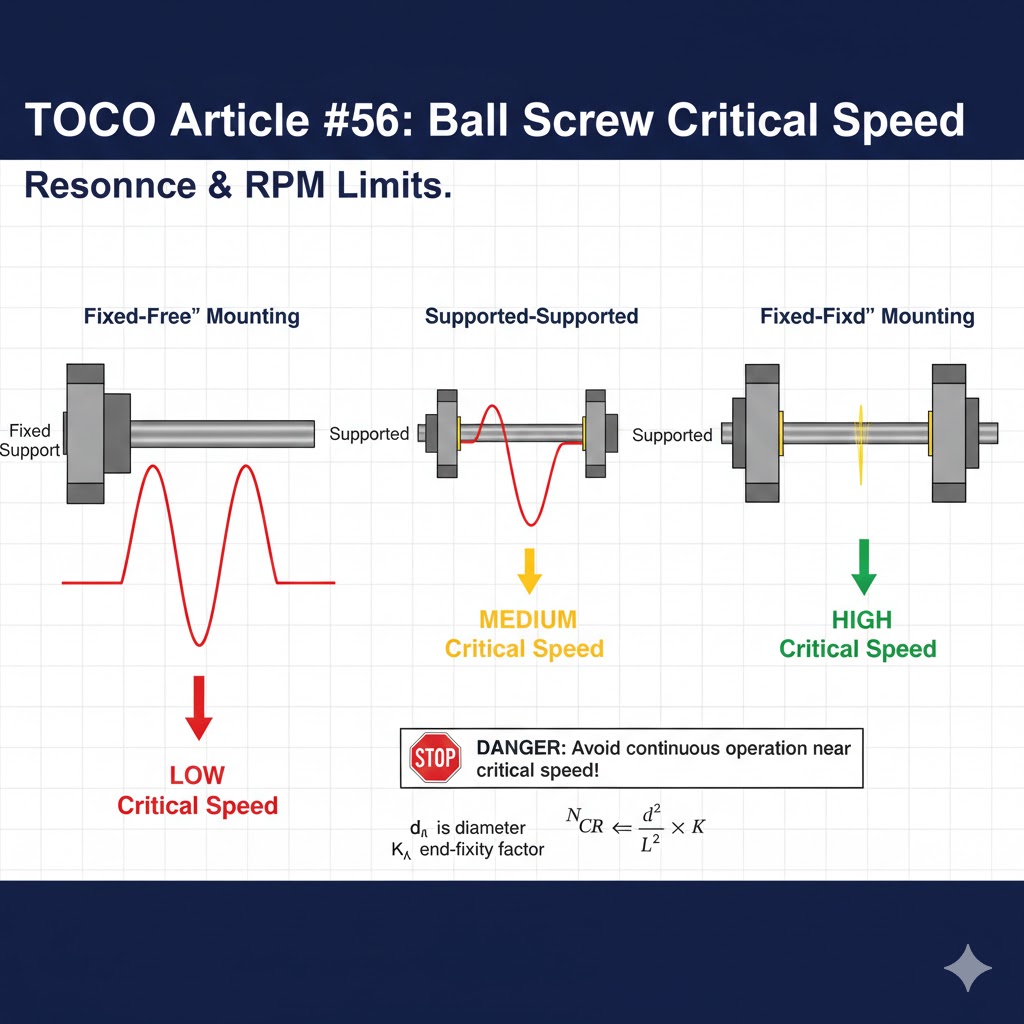
Critical speed is the rotational frequency at which a ball screw begins to resonate. Every shaft has a natural frequency; when the rotation speed matches this frequency, the screw begins to "whip" like a skipping rope. This phenomenon is known as Resonance.
If a TOCO Ball Screw operates at or near this speed, the resulting harmonic vibrations will:
Cause rapid wear on the ball nut and bearing surfaces.
Significantly reduce positioning accuracy.
Potentially bend the screw shaft permanently.
Key Factors Influencing Critical Speed
The critical speed of a shaft is determined by three main variables:
Shaft Diameter: Thicker shafts have higher natural frequencies and higher critical speeds.
Unsupported Length: The longer the distance between bearing supports, the lower the critical speed.
End Fixity (Mounting Style): How the ends of the screw are supported (Fixed, Supported, or Free) drastically changes the vibration limits.
The DN Value: The Nut's Speed Limit
While "Critical Speed" refers to the shaft's vibration, the DN Value refers to the speed limit of the ball circulation system inside the nut.
DN = d x n
Where d is the nominal diameter (mm) and n is the speed (RPM).
For a standard TOCO precision ball screw, exceeding the rated DN value can cause the return tubes to break as the balls collide at high velocities.
How to Avoid Resonance in Your Design
If your application requires higher linear speeds than your current screw allows, consider the following engineering adjustments:
Increase the Lead: Using a "High Lead" screw allows you to achieve faster linear travel at a lower rotational RPM.
Increase Diameter: Swapping a 16mm screw for a 20mm or 25mm version increases stiffness.
Improve End Fixity: Moving from a "Supported-Supported" to a "Fixed-Fixed" bearing arrangement can increase the critical speed by up to 50%.
Use Nut Cooling: In ultra-high-speed applications, thermal expansion can lower the critical speed, making lubrication and cooling essential.
Conclusion
Selecting the right ball screw requires balancing load, accuracy, and speed. By calculating the critical speed during the design phase, you ensure that your TOCO linear system remains stable, quiet, and durable over millions of cycles.
 English
 German
 French
 Russian
 Spanish
 Japanese
 Korean
 Khmer
 Portuguese
 Ukrainian
 Arabic
 Italian
 Afrikaans
 Albanian
 Armenian
 Azerbaijani
 Basque
 Belarusian
 Bulgarian
 Catalan
 Croatian
 Czech
 Danish
 Dutch
 Estonian
 Filipino
 Finnish
 Galician
 Georgian
 Greek
 Haitian Creole
 Hebrew
 Hindi
 Hungarian
 Icelandic
 Indonesian
 Irish
 Latvian
 Lithuanian
 Macedonian
 Malay
 Maltese
 Norwegian
 Persian
 Polish
 Romanian
 Serbian
 Slovak
 Slovenian
 Swahili
 Swedish
 Thai
 Turkish
 Urdu
 Vietnamese
 Welsh
 Yiddish