

In mechanical design, "orientation" usually refers to whether a system is horizontal or vertical. However, there is a more subtle detail that often escapes notice: the orientation of the ball nut itself relative to the load direction.
For TOCO ball screws, particularly in vertical or high-load applications, which end of the nut "faces" the load can significantly impact the distribution of stress and the ultimate service life of the assembly.
The Geometry of Force
A ball nut contains multiple circuits of recirculating balls. While we treat the nut as a single point of force, the load is actually distributed across these circuits.
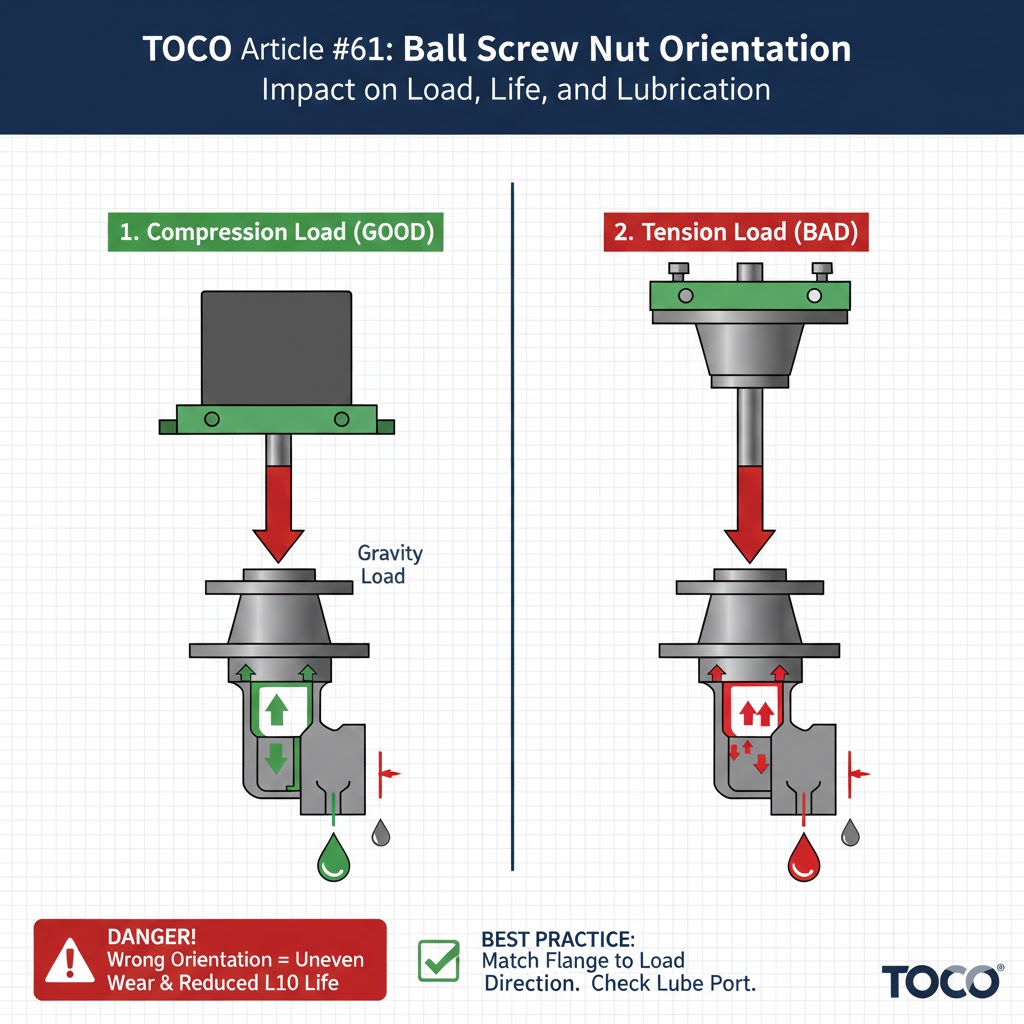
Compression Loading: When the load "pushes" the nut toward the fixed bearing.
Tension Loading: When the load "pulls" the nut away from the fixed bearing.
In a vertical application (like a Z-axis on a CNC), the nut is constantly under a "Gravity Load." If the nut is oriented so that the flange is at the bottom supporting a heavy plate, the internal balls are loaded differently than if the flange is at the top "hanging" the load.
Lubrication and Gravity
Orientation also dictates how your lubrication behaves. If a TOCO ball nut is mounted vertically:
Oil Drainage: Gravity will pull the lubricant toward the bottom seal.
Nut Direction: If the lubrication port is at the "top" of the nut orientation, the oil flows through all circuits. If it is at the "bottom," the top circuits may run dry, leading to localized heat and "pitting" of the races.
Why "Nut Direction" Matters for Life Calculation
When calculating the L10 Life, we assume an even distribution of load. However, if a nut is oriented such that the first circuit takes 60% of the load due to slight misalignment or orientation-induced moment loads, that circuit will fail long before the others. This is why TOCO recommends ensuring the nut is oriented so that the load path is as direct and axial as possible.
Best Practices:
Always match the flange orientation to the primary direction of force to ensure the mounting bolts are in compression rather than tension.
Check the lube port position: Ensure it is positioned to allow gravity to assist, not hinder, the distribution of grease.
Vertical Safety: In vertical orientations, always orient the nut so that a safety "brake" or counter-balance can be easily integrated.
Conclusion
The direction your ball nut faces is not just a matter of assembly convenience—it is a matter of physics.
By optimizing the orientation of your TOCO ball screw nut, you ensure that internal stresses are balanced, lubrication is effective, and your machine stays in peak operating condition.
 English
 German
 French
 Russian
 Spanish
 Japanese
 Korean
 Khmer
 Portuguese
 Ukrainian
 Arabic
 Italian
 Afrikaans
 Albanian
 Armenian
 Azerbaijani
 Basque
 Belarusian
 Bulgarian
 Catalan
 Croatian
 Czech
 Danish
 Dutch
 Estonian
 Filipino
 Finnish
 Galician
 Georgian
 Greek
 Haitian Creole
 Hebrew
 Hindi
 Hungarian
 Icelandic
 Indonesian
 Irish
 Latvian
 Lithuanian
 Macedonian
 Malay
 Maltese
 Norwegian
 Persian
 Polish
 Romanian
 Serbian
 Slovak
 Slovenian
 Swahili
 Swedish
 Thai
 Turkish
 Urdu
 Vietnamese
 Welsh
 Yiddish