

For decades, pneumatic cylinders were the default choice for simple "push-pull" tasks. They were cheap to buy and easy to install. However, when looking at the Total Cost of Ownership (TCO) and energy consumption, the hidden costs of compressed air are staggering.
This article explores why switching to TOCO electric actuators is the fastest way to green-certify a production line.
1. The "Efficiency Gap"
The primary problem with pneumatics is the energy conversion chain. To move a pneumatic cylinder, you must:
Use electricity to run a compressor.
Lose energy as heat during compression.
Lose pressure through leaks in the piping (the "silent killer").
Lose energy through the venting of air at the end of every stroke.
System Efficiency Comparison:
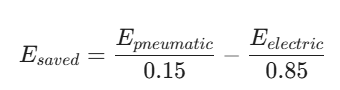
Pneumatic Systems: Typically 10% to 15% efficient.
TOCO Electric Actuators: Typically 80% to 90% efficient.
2. Eliminating the "Silent Killer": Air Leaks
In an average factory, 20% to 30% of all compressed air is lost to leaks before it ever reaches a cylinder. These leaks are often invisible and inaudible. An electric system, such as a TOCO ball screw actuator, uses energy only when it is moving.
When the system is stationary, it consumes almost zero power (holding torque), whereas a pneumatic system requires constant pressure (and thus constant compressor cycles) to maintain a position.
3. Precision vs. "Bang-Bang" Motion
Pneumatic cylinders are generally "bang-bang" devices—they move from one end-stop to the other with little control over speed or intermediate positioning.
Wasted Energy: To stop a heavy pneumatic load, you often have to use "cushioning" or external shock absorbers, which dissipate kinetic energy as wasted heat.
Electric Recovery: TOCO electric modules driven by servo motors can use Regenerative Braking. When the motor slows down a load, it acts as a generator, feeding electricity back into the DC bus or a resistor, further reducing net energy usage.
4. Total Cost of Ownership (TCO) Analysis
While a TOCO electric actuator has a higher initial purchase price than a simple pneumatic cylinder, the ROI (Return on Investment) is often realized in less than 18 months through energy savings alone.
| Feature | Pneumatic Cylinder | TOCO Electric Actuator |
| Initial Cost | Low | Moderate / High |
| Operating Cost | High (Electricity for Compressor) | Low (Direct Drive) |
| Maintenance | High (Seals, Leaks, Filters) | Low (Grease only) |
| Positioning | 2-3 Positions (Fixed) | Infinite (Programmable) |
| Data Feedback | None | Full Diagnostic (Current, Position) |
5. Reducing the Carbon Footprint
Many global manufacturers are now required to report the CO2 emissions of their machinery. Because electric actuators are nearly 8x more efficient than air-based systems, switching a single assembly line to TOCO linear modules can reduce that line’s carbon footprint by several tons of CO2 per year.
Conclusion
The transition from "Air to Electric" is no longer just about precision; it’s about the bottom line.
By eliminating the inefficiencies of compressed air and utilizing the high-precision mechanical advantage of TOCO ball screws, manufacturers can achieve faster cycle times, lower energy bills, and a more sustainable factory floor.
 English
 German
 French
 Russian
 Spanish
 Japanese
 Korean
 Khmer
 Portuguese
 Ukrainian
 Arabic
 Italian
 Afrikaans
 Albanian
 Armenian
 Azerbaijani
 Basque
 Belarusian
 Bulgarian
 Catalan
 Croatian
 Czech
 Danish
 Dutch
 Estonian
 Filipino
 Finnish
 Galician
 Georgian
 Greek
 Haitian Creole
 Hebrew
 Hindi
 Hungarian
 Icelandic
 Indonesian
 Irish
 Latvian
 Lithuanian
 Macedonian
 Malay
 Maltese
 Norwegian
 Persian
 Polish
 Romanian
 Serbian
 Slovak
 Slovenian
 Swahili
 Swedish
 Thai
 Turkish
 Urdu
 Vietnamese
 Welsh
 Yiddish

