

As automation demands higher speeds and longer travel distances, engineers often push TOCO ball screws to their physical limits.
The most dangerous of these limits is the Critical Speed—the rotational velocity that excites the natural frequency of the screw shaft, leading to violent vibration, or "whip."
What is Ball Screw "Whip"?
Imagine a long, thin rod. When rotated slowly, it stays straight. As the RPM increases, centrifugal forces acting on the inherent (though microscopic) imbalance of the shaft cause it to bow outward. At a specific frequency, this bowing becomes resonant. The screw begins to oscillate wildly, which can:
Destroy end-support bearings.
Damage the internal recirculating paths of the ball nut.
Cause the machine to lose positioning accuracy instantly.
The Math: Calculating Critical Speed (nc)
The critical speed of a ball screw is primarily determined by its root diameter (dr), its unsupported length (L), and how the ends are mounted (End Fixity).
The general formula used for TOCO precision screws is:
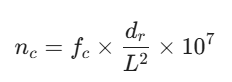
Where:
nc: Critical speed (RPM).
dr: Root diameter of the screw (mm).
L: Unsupported length (mm).
fc: Factor based on the end-support bearing arrangement.
The Impact of End Fixity
The way you support the ends of your TOCO screw dramatically changes its maximum safe speed.
| Mounting Arrangement | fc Factor | Description |
| Fixed - Free | 3.4 | One end supported, one end "floating." (Lowest speed) |
| Supported - Supported | 9.7 | Both ends using simple radial bearings. |
| Fixed - Supported | 15.1 | One end rigid (dual bearings), one end simple. |
| Fixed - Fixed | 21.9 | Both ends rigidly supported. (Highest speed) |
Critical Safety Rule: Never operate a system at 100% of its calculated nc. TOCO recommends a maximum operating speed of 80% (0.8 x nc) to account for real-world misalignments and vibrations.
3 Strategies to Prevent Whip in Long Strokes
1. Increase the Root Diameter
Because nc is directly proportional to dr, a thicker screw is inherently stiffer and has a higher resonant frequency. If your 16mm screw is whipping, upgrading to a 20mm or 25mm shaft is the most direct mechanical solution.
2. Upgrade the End Support
Moving from a "Fixed-Supported" to a "Fixed-Fixed" arrangement increases your speed limit by nearly 45% without changing the screw itself. This requires precision-ground bearing seats on both ends of the TOCO shaft.
3. Use Screw Supports (The "Steady Rest")
For very long strokes (e.g., 4+ meters), even a Fixed-Fixed 50mm screw might whip. In these cases, we use traveling screw supports. these are spring-loaded or cam-driven blocks that support the middle of the screw and "duck" out of the way as the ball nut passes.
The Ultimate Solution: The Rotating Nut
In extreme cases where high speed and extreme length are both required, we flip the design. Instead of spinning the long screw, we keep the screw stationary and rotate the ball nut using a belt-driven motor. Since the screw isn't spinning, "whip" is physically impossible.
Conclusion
"Whip" is a design failure, not a component failure. By accurately calculating nc and respecting the 80% safety margin, you ensure that your TOCO ball screw assembly remains a silent, precise, and durable part of your machine.


 English
 German
 French
 Russian
 Spanish
 Japanese
 Korean
 Khmer
 Portuguese
 Ukrainian
 Arabic
 Italian
 Afrikaans
 Albanian
 Armenian
 Azerbaijani
 Basque
 Belarusian
 Bulgarian
 Catalan
 Croatian
 Czech
 Danish
 Dutch
 Estonian
 Filipino
 Finnish
 Galician
 Georgian
 Greek
 Haitian Creole
 Hebrew
 Hindi
 Hungarian
 Icelandic
 Indonesian
 Irish
 Latvian
 Lithuanian
 Macedonian
 Malay
 Maltese
 Norwegian
 Persian
 Polish
 Romanian
 Serbian
 Slovak
 Slovenian
 Swahili
 Swedish
 Thai
 Turkish
 Urdu
 Vietnamese
 Welsh
 Yiddish

