

Introduction: Beyond the Standard Seal
Even the highest quality TOCO wiper seals have a limit. In environments with hot metal chips, abrasive wood dust, or coolant spray, you need an external barrier. Choosing the right cover isn't just about protection—it’s about ensuring the "shield" doesn't interfere with the machine's travel or precision.
1. Bellows (Accordion Covers)
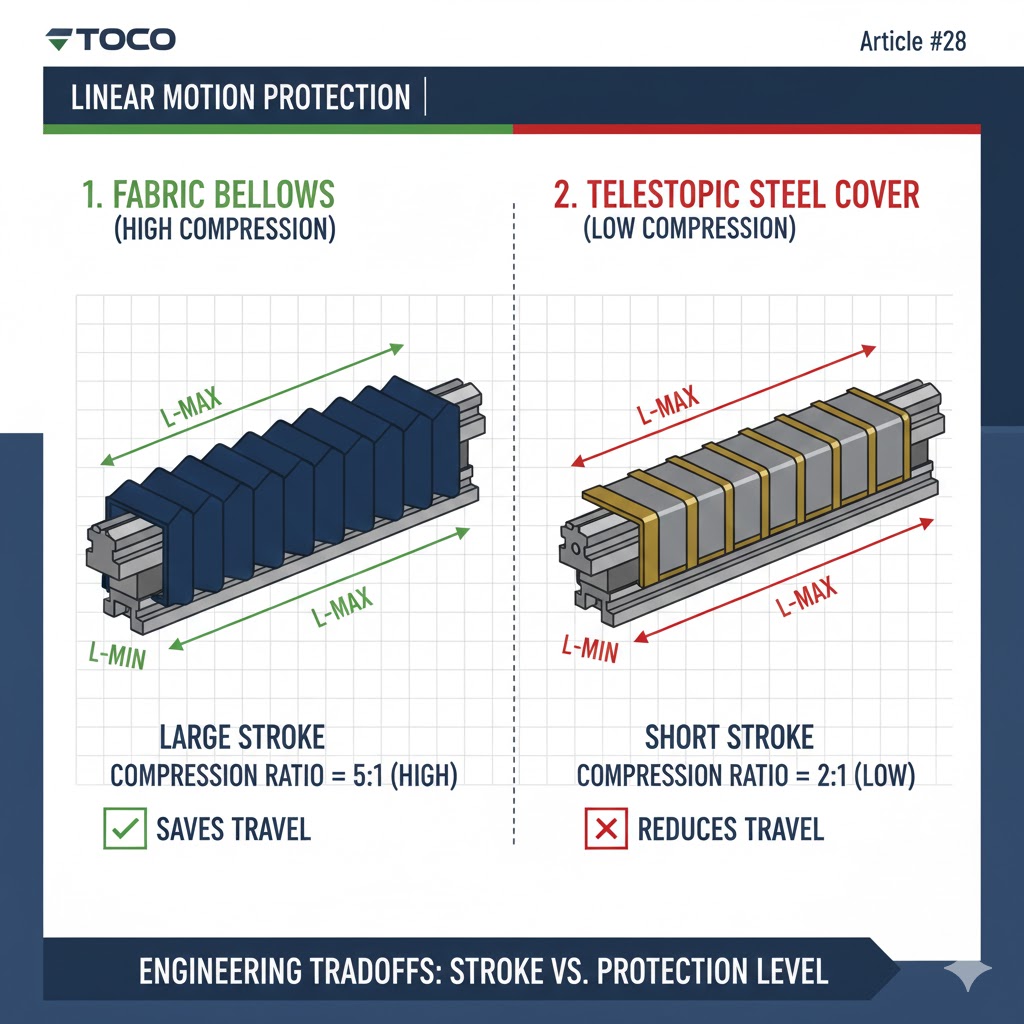
Bellows are the most versatile protection option, made from specialized fabrics, rubbers, or PVC.
The Pros: Lightweight, inexpensive, and capable of high "compression ratios" (they can shrink down very small).
Best For: Woodworking dust, 3D printing, medical equipment, and cleanrooms.
The "Breathing" Factor: Bellows act like a lung. As they move, they suck in and push out air. In dusty environments, it is critical to use filtered vents so the bellows don't "vacuum" dust into the system.
2. Telescopic Steel Covers
For heavy-duty machining, fabric isn't enough. You need the "armor" of steel.
The Pros: Can withstand hot, sharp metal chips and high-pressure coolant. They are walk-on capable in some large-scale machine designs.
Best For: CNC milling centers, lathes, and heavy industrial grinders.
The Weight Penalty: Steel covers are heavy and add significant inertia to the system. You must ensure your motor sizing (using the TOCO Motor Torque Sizing Calculator) accounts for this extra mass.
3. Armored Bellows (The Hybrid)
Armored bellows feature fabric folds protected by stainless steel "lamellas" (plates) on the top surface.
Why Choose This? It gives you the flexibility and high compression of a bellows with the chip-resistance of a steel cover. It is the "best of both worlds" for modern multi-axis machines.
4. Key Specifications for Ordering
When adding a cover to your TOCO assembly, you must provide these four dimensions:
Lmax (Extended Length): The total distance the axis travels.
Lmin (Compressed Length): The "stack height" of the cover when the carriage is at the end of the rail.
Stroke: The difference between Lmax and Lmin. Warning: If the Lmin is too thick, you will lose part of your usable machine travel!
Width and Height: The clearance required to avoid hitting the machine frame or the workpiece.
5. Maintenance of Covers
Covers are wear items. Inspect them monthly for:
Punctures/Tears: Even a tiny hole in a bellows will allow "laps" of abrasive dust to reach the rail.
Wiper Wear: Telescopic covers have brass or rubber wipers between sections. If these wear out, chips will get trapped inside the cover, scratching the steel plates.


 English
 German
 French
 Russian
 Spanish
 Japanese
 Korean
 Khmer
 Portuguese
 Ukrainian
 Arabic
 Italian
 Afrikaans
 Albanian
 Armenian
 Azerbaijani
 Basque
 Belarusian
 Bulgarian
 Catalan
 Croatian
 Czech
 Danish
 Dutch
 Estonian
 Filipino
 Finnish
 Galician
 Georgian
 Greek
 Haitian Creole
 Hebrew
 Hindi
 Hungarian
 Icelandic
 Indonesian
 Irish
 Latvian
 Lithuanian
 Macedonian
 Malay
 Maltese
 Norwegian
 Persian
 Polish
 Romanian
 Serbian
 Slovak
 Slovenian
 Swahili
 Swedish
 Thai
 Turkish
 Urdu
 Vietnamese
 Welsh
 Yiddish

