

When designing a high-precision gantry or a wide-base linear stage, engineers often use two parallel linear guides to support the load.
However, even the highest-grade TOCO linear rails will underperform if they are not perfectly parallel. Misalignment is the "silent killer" of automation, leading to increased friction, uneven wear, and premature system failure.
Why Parallelism Matters
In a dual-axis system, if the two rails are not parallel (either horizontally or vertically), the carriages will fight against each other. This creates a "binding" effect.
Horizontal Misalignment: Causes the carriages to pinch or pull apart as they move.
Vertical Misalignment: Causes one carriage to take a higher load, leading to uneven ball-bearing fatigue.
Symptoms of a Misaligned System
If you encounter any of the following with your TOCO modules, check your alignment immediately:
Inconsistent Motor Torque: The motor works harder at specific points along the travel.
Excessive Noise: A "grinding" or "chattering" sound that disappears when one rail is loosened.
Heat Generation: The carriages feel hot to the touch after only a few cycles.

3 Professional Techniques for Perfect Alignment
To ensure your system reaches its calculated L10 service life, follow these industry-standard installation methods:
1. The Master-Slave Method
Designate one rail as the "Master" rail and bolt it down against a machined shoulder. Use a dial indicator attached to the Master carriage to align the "Slave" rail as you move the stage. This ensures the slave rail follows the exact path of the master.
2. Using an Alignment Bridge
For wide spans, use a rigid "bridge" or the actual worktable to connect the carriages. Slowly move the table from one end to the other, tightening the mounting bolts of the second rail only as the carriage passes them.
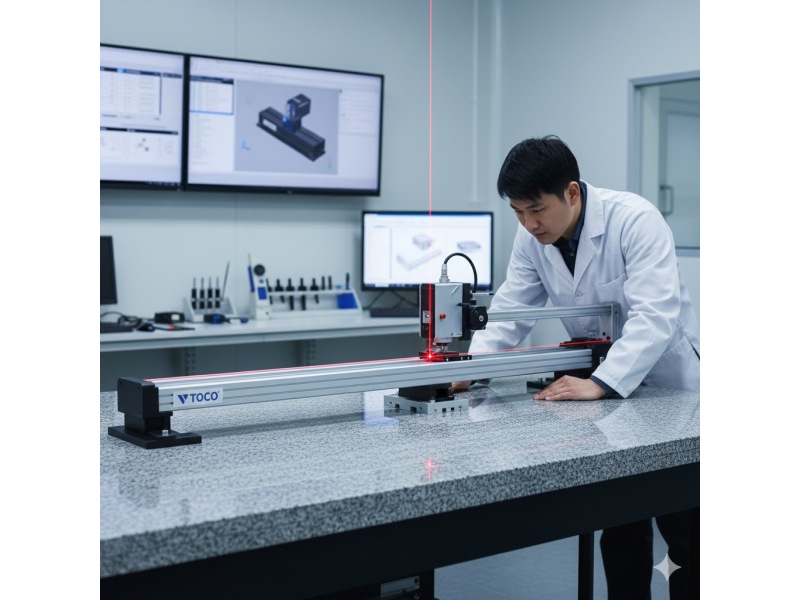
3. Laser Interferometry
For ultra-high-precision applications (CNC or Semiconductor handling), use a laser to verify straightness and parallelism within microns.
Conclusion
High-performance components require high-performance installation. By prioritizing parallelism during the assembly of your TOCO linear guides, you reduce the Total Cost of Ownership (TCO) by preventing unnecessary maintenance and energy loss.


 English
 German
 French
 Russian
 Spanish
 Japanese
 Korean
 Khmer
 Portuguese
 Ukrainian
 Arabic
 Italian
 Afrikaans
 Albanian
 Armenian
 Azerbaijani
 Basque
 Belarusian
 Bulgarian
 Catalan
 Croatian
 Czech
 Danish
 Dutch
 Estonian
 Filipino
 Finnish
 Galician
 Georgian
 Greek
 Haitian Creole
 Hebrew
 Hindi
 Hungarian
 Icelandic
 Indonesian
 Irish
 Latvian
 Lithuanian
 Macedonian
 Malay
 Maltese
 Norwegian
 Persian
 Polish
 Romanian
 Serbian
 Slovak
 Slovenian
 Swahili
 Swedish
 Thai
 Turkish
 Urdu
 Vietnamese
 Welsh
 Yiddish

