

In the world of high-speed automation, throughput is everything. When designing a pick-and-place robot or a precision dispensing station, engineers usually face a fork in the road: Do I use a TOCO ball screw driven module, or do I invest in a linear motor?
Both technologies can achieve micron-level precision, but they differ significantly in how they handle speed, acceleration, and cost.
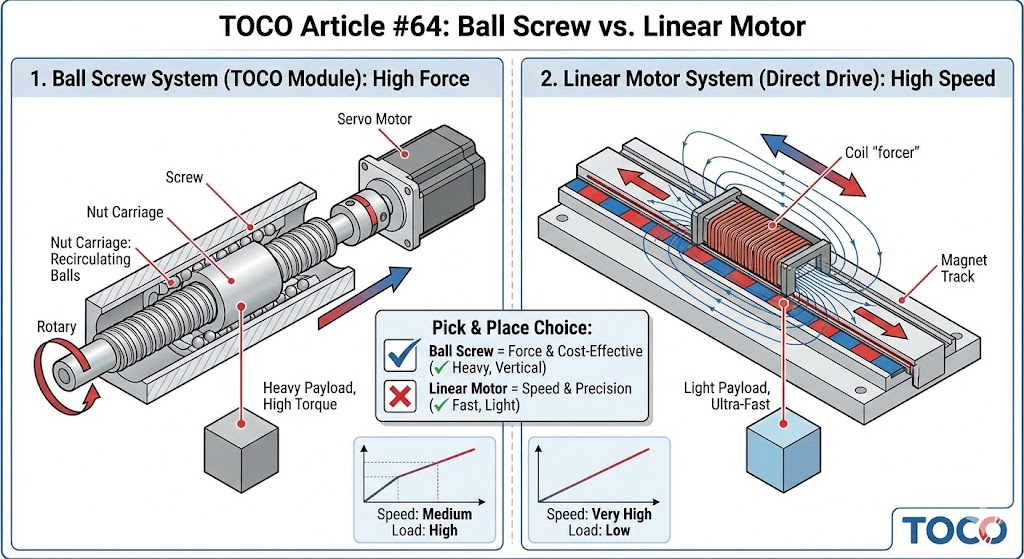
1. Ball Screw Drives: The High-Force Workhorse
A ball screw converts rotary motion into linear motion through a mechanical "gearing" effect.
The Strength: Massive mechanical advantage. A small motor can move a very heavy load because the screw acts as a force multiplier.
Safety: In a vertical pick-and-place application, ball screws are safer. If power is lost, the friction and pitch of the screw prevent the load from "free-falling" as easily as a direct-drive system.
Cost: Significantly more budget-friendly than linear motors, making them the standard for 80% of industrial tasks.
2. Linear Motors: The Speed Champion
A linear motor is essentially a rotary motor that has been "unrolled." It drives the load directly using electromagnetic force without any mechanical contact.
The Strength: Speed and Acceleration. While ball screws are limited by "screw whip" at high RPMs, linear motors can exceed 10g of acceleration and 10m/s velocity.
Precision: Because there is no mechanical coupling or screw to deflect, linear motors offer sub-micron repeatability and zero backlash.
Maintenance: With no balls to recirculate or grease to dry out, linear motors are virtually maintenance-free.
The "Settling Time" Factor
In pick-and-place cycles, the "move" is only half the battle. You also have to wait for the system to stop vibrating before you can pick up a part.
Ball Screws have more inertia and mechanical damping, which can sometimes help them settle faster in heavy applications.
Linear Motors have almost zero damping; they rely entirely on the servo controller's "tuning" to stop. For lightweight electronic components, a well-tuned linear motor will always win the cycle-time race.
Summary Comparison Table
| Feature | TOCO Ball Screw | Linear Motor |
| Max Velocity | ≈ 2.5m/s | 10+m/s |
| Acceleration | 1.0 -1.5g | Up to 10g |
| Thrust Force | Very High | Limited by Magnet Size |
| System Cost | $$$ | $$$$$ |
| Vertical Load | Excellent (Mechanical hold) | Difficult (Requires brakes) |
Conclusion
If your pick-and-place application involves moving heavy parts with high precision at a reasonable cost, TOCO ball screw modules are the optimal choice.
However, if you are building a semiconductor scanner or a high-speed micro-electronic assembly line where every millisecond of "air time" costs money, the investment in a linear motor is justified by the massive leap in throughput.
 English
 German
 French
 Russian
 Spanish
 Japanese
 Korean
 Khmer
 Portuguese
 Ukrainian
 Arabic
 Italian
 Afrikaans
 Albanian
 Armenian
 Azerbaijani
 Basque
 Belarusian
 Bulgarian
 Catalan
 Croatian
 Czech
 Danish
 Dutch
 Estonian
 Filipino
 Finnish
 Galician
 Georgian
 Greek
 Haitian Creole
 Hebrew
 Hindi
 Hungarian
 Icelandic
 Indonesian
 Irish
 Latvian
 Lithuanian
 Macedonian
 Malay
 Maltese
 Norwegian
 Persian
 Polish
 Romanian
 Serbian
 Slovak
 Slovenian
 Swahili
 Swedish
 Thai
 Turkish
 Urdu
 Vietnamese
 Welsh
 Yiddish