

Operating a linear system in a vacuum is not as simple as placing a standard module into a chamber. In environments like semiconductor wafer processing or space simulation, the laws of physics change the way materials behave.
For TOCO linear components, the two biggest enemies in a vacuum are Outgassing and Cold Welding.
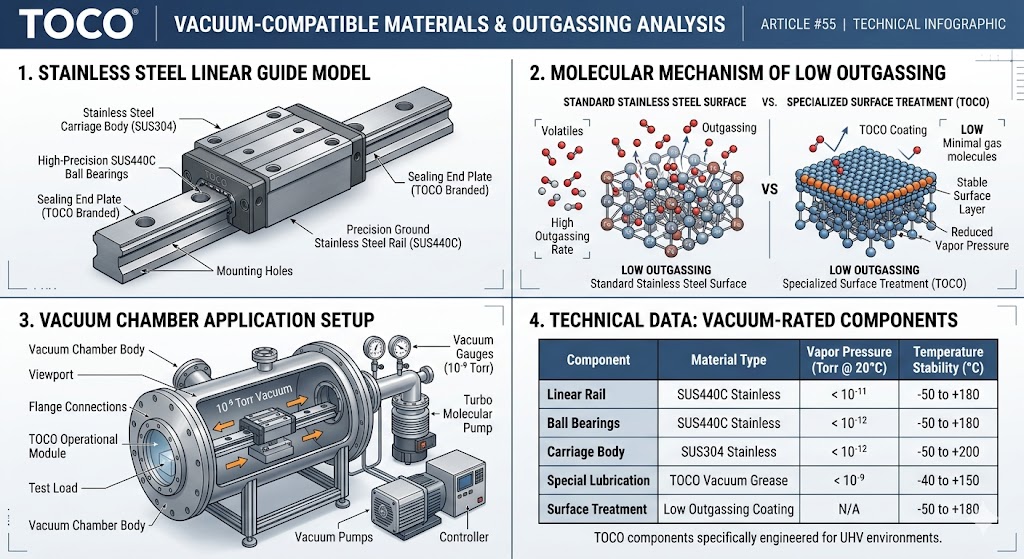
The Challenge of Outgassing
In a high vacuum, standard industrial greases and plastics undergo "outgassing." This is where volatile compounds evaporate from the material, creating a "cloud" of contaminants.
The Risk: These particles can settle on expensive optical lenses, ruin silicon wafers, or cause the lubricant to become brittle and lose its effectiveness.
The Solution: TOCO vacuum-compatible systems utilize specialized perfluorinated polyether (PFPE) lubricants that have extremely low vapor pressure.
Preventing "Cold Welding"
In Earth's atmosphere, a thin layer of oxide naturally forms on metal surfaces, acting as a microscopic barrier. In a deep vacuum, this oxide layer can wear away and not reform.
The Risk: Without oxygen, two clean metal surfaces (like a ball bearing and a race) that touch can actually fuse together. This is called Cold Welding.
The Solution: We utilize surface treatments like Hard Chrome Plating or Raydent and specialized stainless steel alloys (like 440C) to ensure the surfaces remain distinct and low-friction even without an oxide layer.
Why Vented Screws are Essential
Air trapped in blind holes (like the bottom of a tapped hole for a mounting bolt) can leak out slowly over days, making it impossible for the vacuum pump to reach the desired pressure level. This is known as a Virtual Leak.
TOCO Engineering Tip: For vacuum applications, we recommend "Vented Screws"—bolts with a hole drilled through the center to allow trapped air to escape instantly during the pump-down phase.
Thermal Management Without Air
In a normal factory, heat dissipates through the air (convection). In a vacuum, there is no air. Heat can only move through Conduction (through the rails) or Radiation.
Design Note: Systems must be derated for duty cycle, as the TOCO ball nut will retain heat much longer than it would in a standard environment, potentially leading to thermal expansion and loss of precision.
Conclusion
Designing for a vacuum requires a departure from standard "off-the-shelf" thinking.
By selecting vacuum-grade lubricants, utilizing anti-friction coatings, and accounting for virtual leaks, your TOCO linear motion system will provide the same reliability in a vacuum chamber as it does on the factory floor.


 English
 German
 French
 Russian
 Spanish
 Japanese
 Korean
 Khmer
 Portuguese
 Ukrainian
 Arabic
 Italian
 Afrikaans
 Albanian
 Armenian
 Azerbaijani
 Basque
 Belarusian
 Bulgarian
 Catalan
 Croatian
 Czech
 Danish
 Dutch
 Estonian
 Filipino
 Finnish
 Galician
 Georgian
 Greek
 Haitian Creole
 Hebrew
 Hindi
 Hungarian
 Icelandic
 Indonesian
 Irish
 Latvian
 Lithuanian
 Macedonian
 Malay
 Maltese
 Norwegian
 Persian
 Polish
 Romanian
 Serbian
 Slovak
 Slovenian
 Swahili
 Swedish
 Thai
 Turkish
 Urdu
 Vietnamese
 Welsh
 Yiddish

