

Introduction: The War Against Contamination
Precision linear motion depends on a clean interface between the ball bearings and the raceway. In industries like woodworking, metal machining, or glass cutting, airborne debris is the #1 cause of premature failure.
This article explores the specialized shielding options for TOCO Linear Modules and Mono Stages that keep contaminants out and lubrication in.
1. The First Line of Defense: End Seals and Side Seals
Every standard TOCO block comes equipped with high-performance synthetic rubber seals.
End Seals: These wipe the rail surface clean as the carriage moves.
Side Seals: These prevent dust from entering the bearing raceways from the bottom or sides.
Double Seals: For heavy-dust environments, we offer double-lipped seals that provide twice the wiping power.
2. Metal Scrapers: For "Hot" and "Sharp" Debris
Rubber seals are great for dust, but they can be damaged by hot metal sparks or sharp wood chips.
Function: A stainless steel scraper is mounted in front of the rubber seal. It "plows" away large chips and cooled weld spatter before they can reach the delicate rubber lip.
Application: Essential for CNC milling and welding robots.
3. Bellows and Covers: Total System Protection
When the entire rail must be protected from a "shower" of debris or liquid, external covers are necessary.
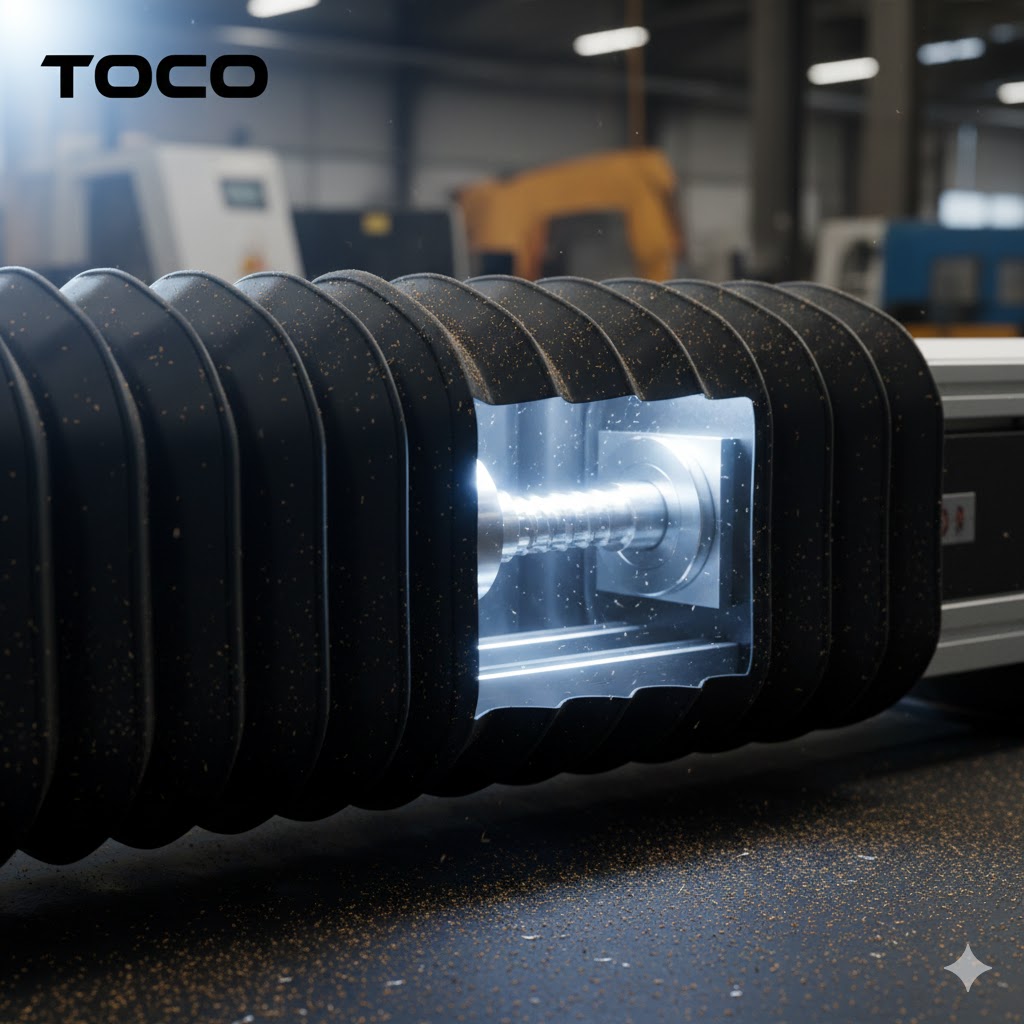
Folded Bellows: These accordion-style covers expand and contract with the stroke. They offer high flexibility and protect the ball screw and rails from all angles.
Telescopic Steel Covers: For the most extreme environments (heavy machining), sliding steel plates provide a bulletproof shield against high-velocity chips.
4. Self-Lubricating Kits (The "Green" Solution)
Contamination often "sucks" the oil out of a system. TOCO’s self-lubricating units (oil reservoirs) sit behind the seals, constantly bathing the raceway in a thin film of oil. This ensures that even if some dust enters, the friction remains low and the system self-cleans.

 English
 German
 French
 Russian
 Spanish
 Japanese
 Korean
 Khmer
Khmer Portuguese
 Ukrainian
 Arabic
 Italian
 Afrikaans
 Albanian
 Armenian
 Azerbaijani
 Basque
 Belarusian
 Bulgarian
 Catalan
 Croatian
 Czech
Czech Danish
 Dutch
Dutch Estonian
 Filipino
 Finnish
 Galician
 Georgian
 Greek
Greek Haitian Creole
 Hebrew
 Hindi
Hindi Hungarian
 Icelandic
 Indonesian
 Irish
Irish Latvian
 Lithuanian
 Macedonian
 Malay
Malay Maltese
 Norwegian
 Persian
 Polish
 Romanian
 Serbian
 Slovak
 Slovenian
 Swahili
 Swedish
 Thai
Thai Turkish
 Urdu
Urdu Vietnamese
 Welsh
Welsh Yiddish