

A TOCO linear module is only as precise as the connection to its drive motor. In 2026, as high-speed "start-stop" cycles become more aggressive, the choice of shaft coupling—specifically for TGH (Ball Screw) and TGB (Belt) series—can be the difference between sub-micron repeatability and a system that vibrates itself apart.
1. Why Standard Couplings Won't Cut It
In high-precision motion, we must eliminate two primary enemies:
Backlash: Any "play" or looseness in the connection. If the motor turns 1℃ but the screw doesn't move, your positioning data is a lie.
Misalignment: No matter how precisely a motor is mounted, there is always a microscopic offset ($\Delta$) between the motor shaft and the module input shaft. A rigid connection would destroy the bearings; a flexible one must absorb this without losing accuracy.
2. The TOCO Preferred Choice: Disk (Leaf) Couplings
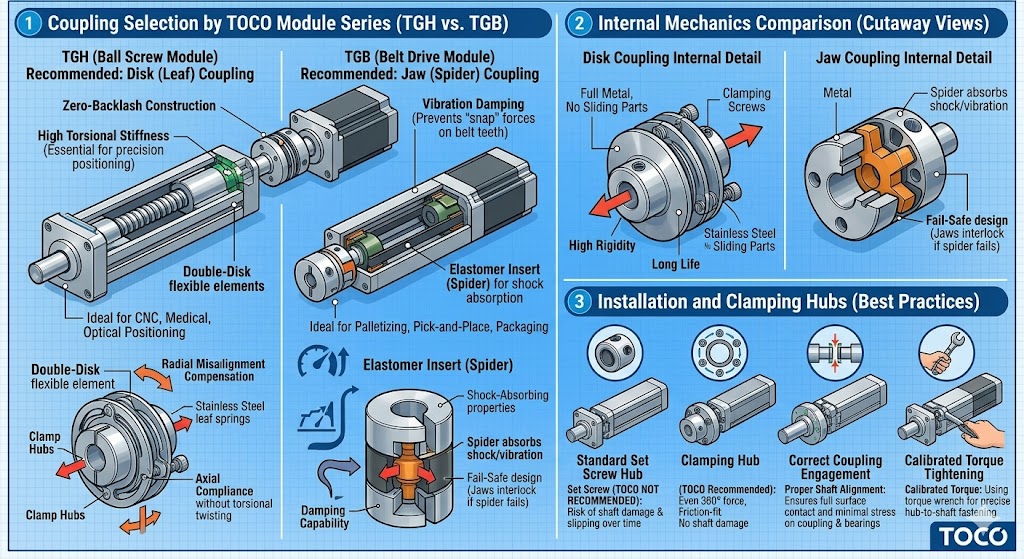
For the TGH Ball Screw series, we almost exclusively recommend Single or Double Disk Couplings.
Construction: These use thin stainless steel springs (disks) to transmit torque.
The Benefit: They are "Torsionally Rigid" (meaning they don't twist under load) but "Flexibly Compliant" (meaning they can bend to accommodate shaft misalignment).
Zero Backlash: Because there are no sliding parts, there is zero "slop" in the rotation.
3. The "High-Damping" Choice: Jaw (Spider) Couplings
For the TGB Belt Drive series, where high-speed transport and vibration dampening are more important than absolute sub-micron positioning, Jaw Couplings are the standard.
Construction: Two metal hubs "sandwich" a curved elastomer insert (the "Spider").
The Benefit: The elastomer absorbs the shock of rapid direction changes, protecting the motor’s internal bearings and the module’s belt teeth from "snap" forces.
Fail-Safe: Even if the spider fails, the metal jaws will interlock, preventing a total runaway of the load.
4. Coupling Selection Matrix for TOCO Modules
| Feature | Disk Coupling (TGH Recommended) | Jaw Coupling (TGB Recommended) |
| Backlash | Absolute Zero | Low (Zero with "Preload" spider) |
| Torsional Stiffness | Very High | Moderate |
| Vibration Damping | Low | High |
| Best For | CNC, Medical, Optical Positioning | Palletizing, Pick-and-Place, Packaging |
5. Proper Installation: The "Clamp" vs. "Set Screw"
To ensure the facts of your machine's performance match the technical specs, TOCO recommends Clamping Hubs over Set Screws.
Set Screws: Can slip over time and mar the motor shaft, making removal difficult.
Clamping: Distributes the force 360° around the shaft. This provides a much more secure "friction-fit" capable of handling the high torque of 2026-era servo motors without slipping.
Conclusion
The coupling is the final link in the precision chain. By matching a Torsionally Rigid Disk Coupling to your TGH module or a Damping Jaw Coupling to your TGB module, you protect your motor while ensuring that every pulse from the controller results in perfect, predictable motion.
 English
 German
 French
 Russian
 Spanish
 Japanese
 Korean
 Khmer
 Portuguese
 Ukrainian
 Arabic
 Italian
 Afrikaans
 Albanian
 Armenian
 Azerbaijani
 Basque
 Belarusian
 Bulgarian
 Catalan
 Croatian
 Czech
 Danish
 Dutch
 Estonian
 Filipino
 Finnish
 Galician
 Georgian
 Greek
 Haitian Creole
 Hebrew
 Hindi
 Hungarian
 Icelandic
 Indonesian
 Irish
 Latvian
 Lithuanian
 Macedonian
 Malay
 Maltese
 Norwegian
 Persian
 Polish
 Romanian
 Serbian
 Slovak
 Slovenian
 Swahili
 Swedish
 Thai
 Turkish
 Urdu
 Vietnamese
 Welsh
 Yiddish

