

The biggest cost in modern automation isn't the price of a ball screw—it's the cost of the production line stopping unexpectedly.
In an Industry 4.0 environment, "Smart" TOCO linear modules use integrated sensors to provide a constant stream of data, allowing for Predictive Maintenance (PdM) that maximizes uptime and optimizes service intervals.
From Scheduled to Smart Maintenance
Traditionally, maintenance was done on a schedule (e.g., "grease every 6 months"). However, this often leads to "over-maintenance" (wasting resources) or "under-maintenance" (risking failure).
The Smart Solution: By embedding sensors directly into the carriage or nut flange, we can monitor the actual health of the component based on real-world usage.
Key Sensor Technologies for TOCO Systems
To turn a standard linear axis into a smart asset, we focus on four primary data points:
1. Vibration Analysis (Accelerometers)
Vibration is the "voice" of a bearing. Integrated micro-electromechanical systems (MEMS) accelerometers detect high-frequency "chatter" or "spiking." An increase in vibration often indicates the start of pitting on the races or a broken ball bearing.
2. Thermal Monitoring (Infrared & Thermistors)
Excessive heat is the number one indicator of poor lubrication or misalignment. Smart sensors at the nut flange monitor temperature trends. If the temperature deviates from the "healthy" baseline, the system can trigger an automatic lubrication pulse.
3. Acoustic Emission (Ultrasonic)
Before a vibration is even felt, it can be heard. Ultrasonic sensors detect the "stress waves" generated by internal friction. This is the earliest possible warning sign of lubricant starvation.
4. Wear & Displacement Sensors
Inductive or magnetic sensors can measure the microscopic "play" or backlash in a ball nut. If the gap between the ball and the race increases beyond a set threshold, the system flags the part for replacement during the next planned shutdown.
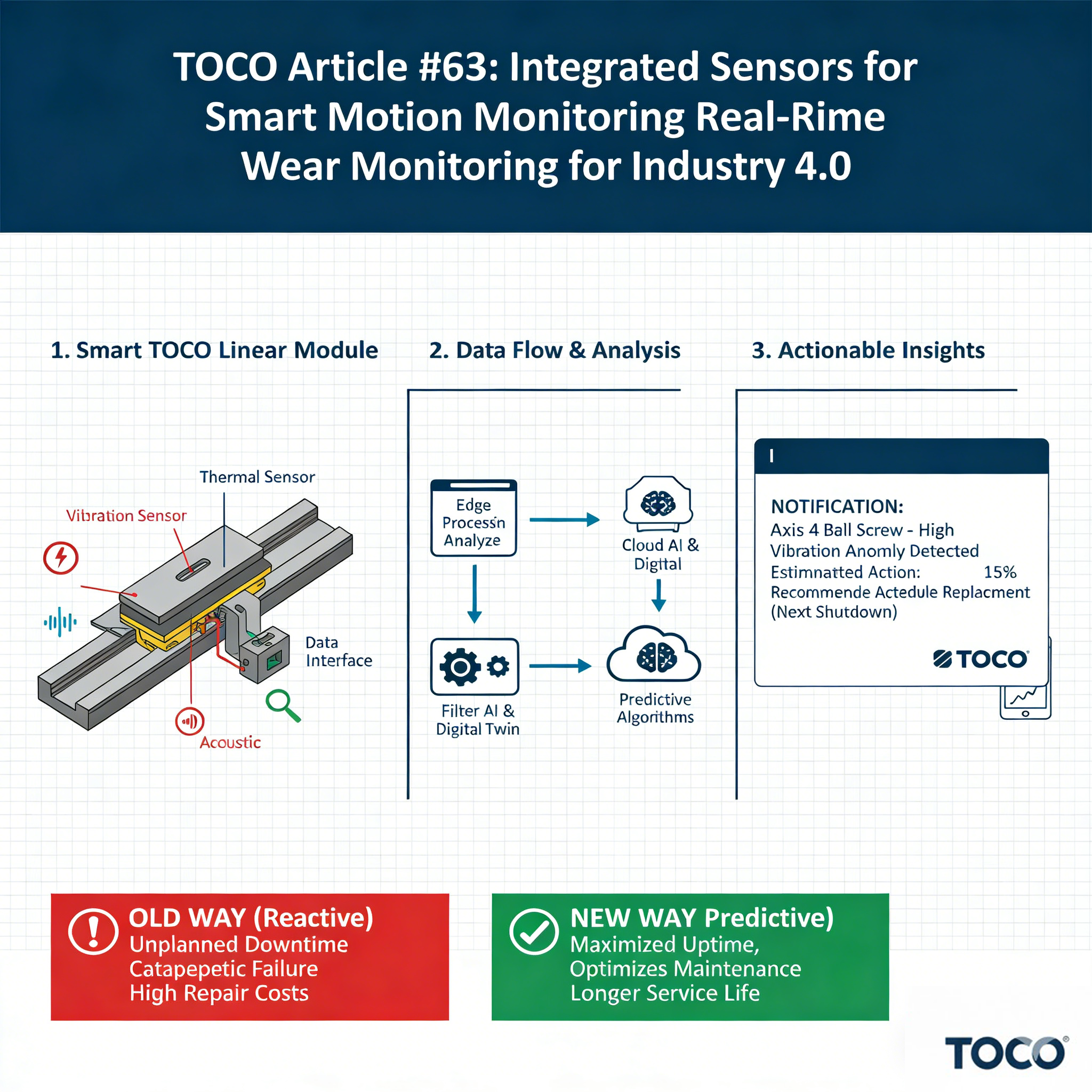
The Path of Data: Edge to Cloud
Sensing: The sensor on the TOCO module captures raw data (analog/digital).
Edge Processing: A local controller (like a PLC or IoT Gateway) filters the noise and looks for "Abnormality Scores."
Cloud Analysis: AI algorithms compare the data to "Digital Twins" to predict exactly how many hours of life remain.
Action: A notification is sent to the maintenance team's dashboard: "Axis 4 Ball Screw: 15% life remaining. Order replacement part."
Conclusion
Integrating sensors into your TOCO motion systems transforms them from passive mechanical parts into active participants in your factory's efficiency.
By listening to what your machines are telling you in real-time, you eliminate the "surprise" of failure and secure the future of your production.
 English
 German
 French
 Russian
 Spanish
 Japanese
 Korean
 Khmer
 Portuguese
 Ukrainian
 Arabic
 Italian
 Afrikaans
 Albanian
 Armenian
 Azerbaijani
 Basque
 Belarusian
 Bulgarian
 Catalan
 Croatian
 Czech
 Danish
 Dutch
 Estonian
 Filipino
 Finnish
 Galician
 Georgian
 Greek
 Haitian Creole
 Hebrew
 Hindi
 Hungarian
 Icelandic
 Indonesian
 Irish
 Latvian
 Lithuanian
 Macedonian
 Malay
 Maltese
 Norwegian
 Persian
 Polish
 Romanian
 Serbian
 Slovak
 Slovenian
 Swahili
 Swedish
 Thai
 Turkish
 Urdu
 Vietnamese
 Welsh
 Yiddish