

I. What is a Ball Screw? The Precision Converter
At its core, a Ball Screw is a mechanical linear actuator that performs one of the most vital tasks in automated machinery: converting rotational motion into precise linear motion.
In a CNC (Computer Numerical Control) machine, a servo motor provides the rotation, and the ball screw assembly translates that rotation into the exact, linear movement required to position the cutting tool or the workpiece along the X, Y, or Z axes.
Core Components of a High-Precision Ball Screw Assembly
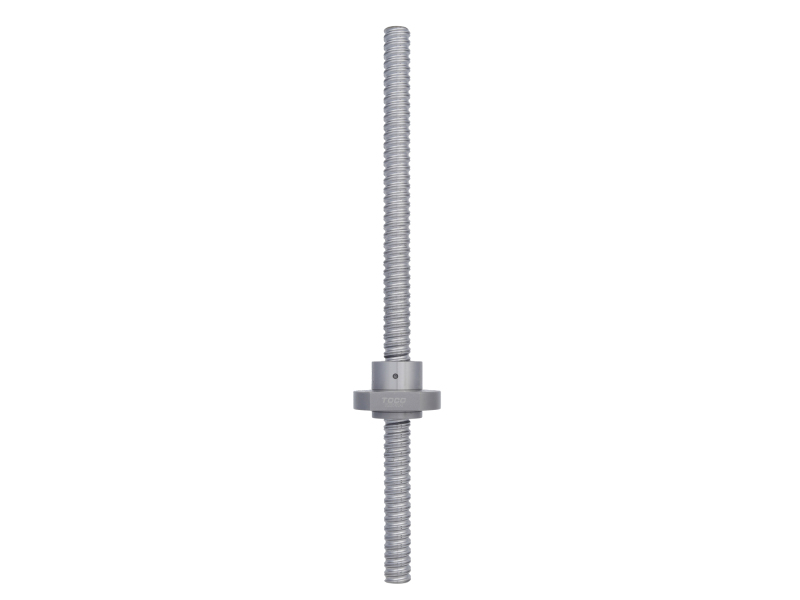
Screw Shaft: The hardened, precision-ground cylindrical rod featuring continuous helical grooves (raceways). It receives the rotational force.
Ball Nut: The cylindrical component that houses the recirculating mechanism. It features internal raceways matching the screw, allowing the rolling elements to travel.
Recirculating Balls: The precision-ground steel (or sometimes ceramic) balls that roll between the shaft and the nut. This is the mechanism that defines the ball screw's superior efficiency and precision.
Recirculation System: Channels within the nut that pick up the balls at the end of their path and redirect them to the start of the circuit for continuous, smooth rolling.
II. The Four Critical Advantages in CNC Precision
Ball screws are preferred over traditional Lead Screws (Acme screws) in CNC machines because their design eliminates the primary flaw of sliding contact, which is friction and wear. The use of rolling elements provides four essential benefits:
1. Superior Efficiency and Speed
Due to the conversion from sliding friction to rolling friction, the coefficient of friction is exceptionally low (typically 0.003 - 0.005). This results in a mechanical efficiency of over 90%.
Impact on CNC: Minimal energy is lost as heat. This allows CNC machines to achieve much higher rapid traverse speeds and acceleration rates while maintaining thermal stability during long, continuous operations.
2. Exceptional Positional Accuracy
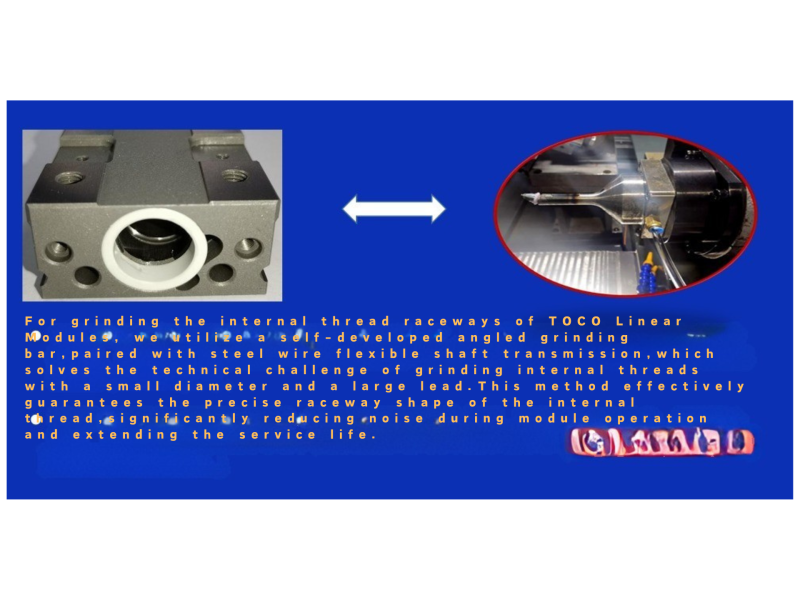
High-precision ball screws are manufactured using meticulous processes like thread grinding (versus rolling) to ensure minimal deviation in the screw’s lead (the linear distance traveled per revolution).
Impact on CNC: This precision ensures that the distance commanded by the CNC controller is the exact distance the tool travels, making micrometer-level accuracy possible for cutting intricate parts and maintaining extremely tight tolerances.
3. Eliminating Backlash (Preloading)
Backlash (or axial play) is the slop or clearance between the screw and the nut. In CNC, backlash leads to positioning errors every time the axis changes direction.
TOCO Solution: High-precision ball screws are preloaded—an axial force is applied to slightly compress the components, effectively eliminating the internal gap. This ensures immediate, accurate response to rotational changes, which is non-negotiable for high-quality CNC cutting.
4. High Rigidity and Load Handling
The large contact area between the balls and the raceways allows the ball screw to handle significant axial loads (the force along the length of the screw) without deforming.
Impact on CNC: During heavy-duty milling, the cutting forces exert tremendous pressure. The high rigidity of the ball screw prevents elastic deformation, maintaining the geometric accuracy of the cutting path and improving the final surface finish.
III. Application in Key CNC Machine Axes
The ball screw is indispensable across all major types of CNC equipment:
| CNC Application | Role of the Ball Screw | Impact on Output |
| Milling Machines | Drives the X, Y, and Z axes for tool positioning. | Ensures precise depth of cut and detailed contour accuracy. |
| CNC Lathes | Controls the feed axis (often X and Z) for the cutting tool. | Provides stable, accurate feed rates for smooth surface finishes on turned parts. |
| Laser/Plasma Cutters | Controls the movement of the cutting head across the gantry. | Delivers the high-speed, repeatable micro-level positioning required for sharp, clean edges. |
| High-End 3D Printers | Drives the build plate or extruder carriage. | Crucial for the layer-by-layer precision necessary for complex industrial prototypes. |
IV. TOCO’s Commitment to CNC Precision
Selecting a ball screw is an engineering decision that directly affects the lifetime performance and precision of a CNC machine.
TOCO specializes in providing OEM/ODM ball screws with the required Accuracy Grades (e.g., C3, C5) achieved through rigorous thread grinding and assembly. We focus on controlling the critical parameters—such as lead accuracy and effective preload—that make the difference between a functional machine and a truly high-precision CNC system.
Choosing TOCO ensures your final machine design benefits from the highest levels of precision and durability available in the market.

 English
 German
 French
 Russian
 Spanish
 Japanese
 Korean
 Khmer
Khmer Portuguese
 Ukrainian
 Arabic
 Italian
 Afrikaans
 Albanian
 Armenian
 Azerbaijani
 Basque
 Belarusian
 Bulgarian
 Catalan
 Croatian
 Czech
Czech Danish
 Dutch
Dutch Estonian
 Filipino
 Finnish
 Galician
 Georgian
 Greek
Greek Haitian Creole
 Hebrew
 Hindi
Hindi Hungarian
 Icelandic
 Indonesian
 Irish
Irish Latvian
 Lithuanian
 Macedonian
 Malay
Malay Maltese
 Norwegian
 Persian
 Polish
 Romanian
 Serbian
 Slovak
 Slovenian
 Swahili
 Swedish
 Thai
Thai Turkish
 Urdu
Urdu Vietnamese
 Welsh
Welsh Yiddish