

In a high-speed production line, a single seized linear module can cost thousands of dollars in downtime. While visual inspections are standard, the most advanced way to monitor a TOCO TGH or TGB module is through Acoustic Signature Analysis—using high-frequency sound to detect microscopic defects long before they become visible.
1. The Sound of a Healthy Bearing
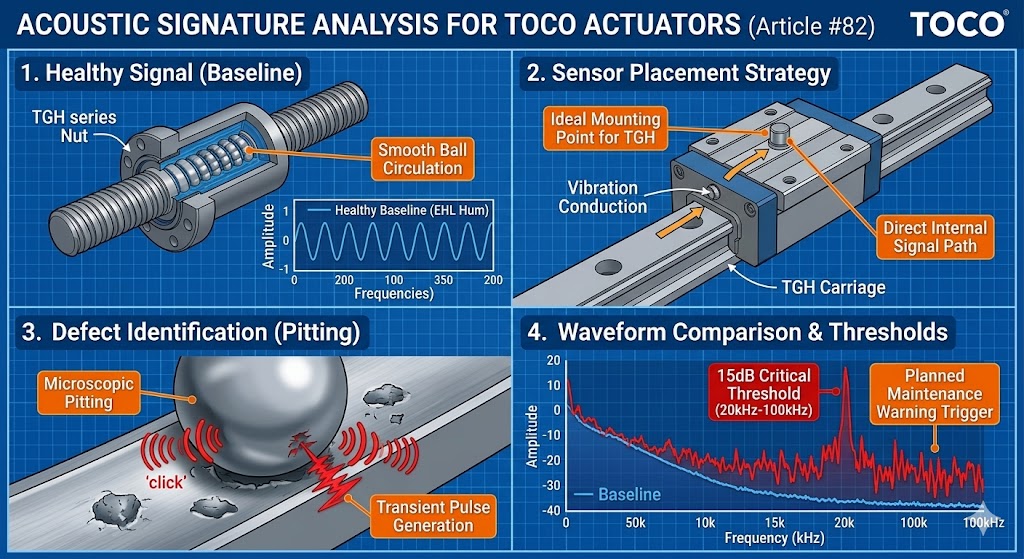
A new, well-lubricated ball screw operates with a consistent, low-decibel "hum." This sound is produced by the balls circulating through the return tubes. In a healthy system, the frequency spectrum is flat, indicating smooth Elastohydrodynamic Lubrication (EHL).
2. Identifying the "Click" of Pitting
When the raceway begins to fail, a phenomenon called "pitting" occurs—tiny craters form on the steel surface. As the balls pass over these craters, they create a high-frequency transient pulse (a "click" or "pop" in the ultrasonic range).
The Symptom: A spike in the 20kHz to 100kHz range.
The Cause: Usually contaminated grease or an overloaded moment (Ma/Mb).
3. Sensor Placement on TOCO Modules
To get an accurate "signature," acoustic emission (AE) sensors should be mounted as close to the ball nut as possible.
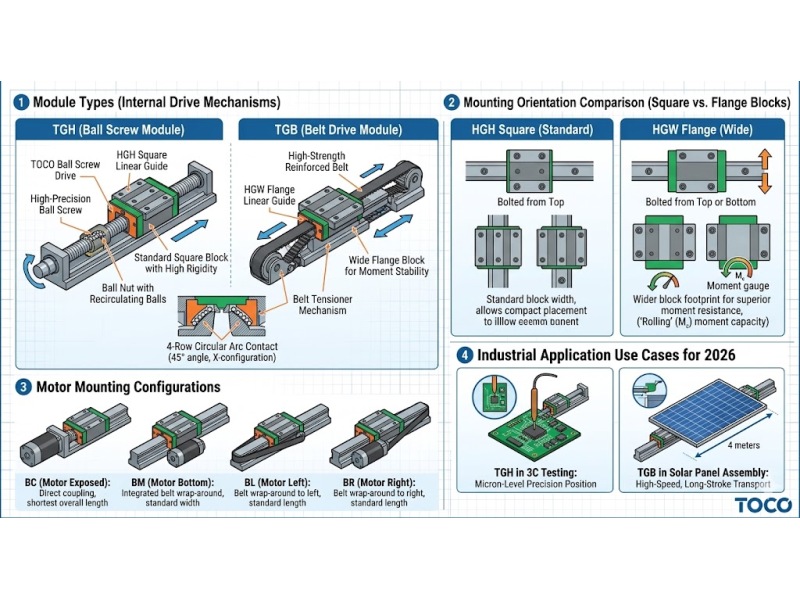
On a TOCO TGH actuator, the ideal mounting point is the aluminum carriage block, which acts as a bridge for the internal vibrations of the ball screw.
4. Transitioning to Predictive Maintenance
By recording a "baseline" sound profile when the machine is new, maintenance teams can set threshold alarms.
If the high-frequency energy increases by 10dB to 15dB, it serves as an early warning to re-lubricate or schedule a carriage replacement during planned downtime.
 English
 German
 French
 Russian
 Spanish
 Japanese
 Korean
 Khmer
 Portuguese
 Ukrainian
 Arabic
 Italian
 Afrikaans
 Albanian
 Armenian
 Azerbaijani
 Basque
 Belarusian
 Bulgarian
 Catalan
 Croatian
 Czech
 Danish
 Dutch
 Estonian
 Filipino
 Finnish
 Galician
 Georgian
 Greek
 Haitian Creole
 Hebrew
 Hindi
 Hungarian
 Icelandic
 Indonesian
 Irish
 Latvian
 Lithuanian
 Macedonian
 Malay
 Maltese
 Norwegian
 Persian
 Polish
 Romanian
 Serbian
 Slovak
 Slovenian
 Swahili
 Swedish
 Thai
 Turkish
 Urdu
 Vietnamese
 Welsh
 Yiddish

