

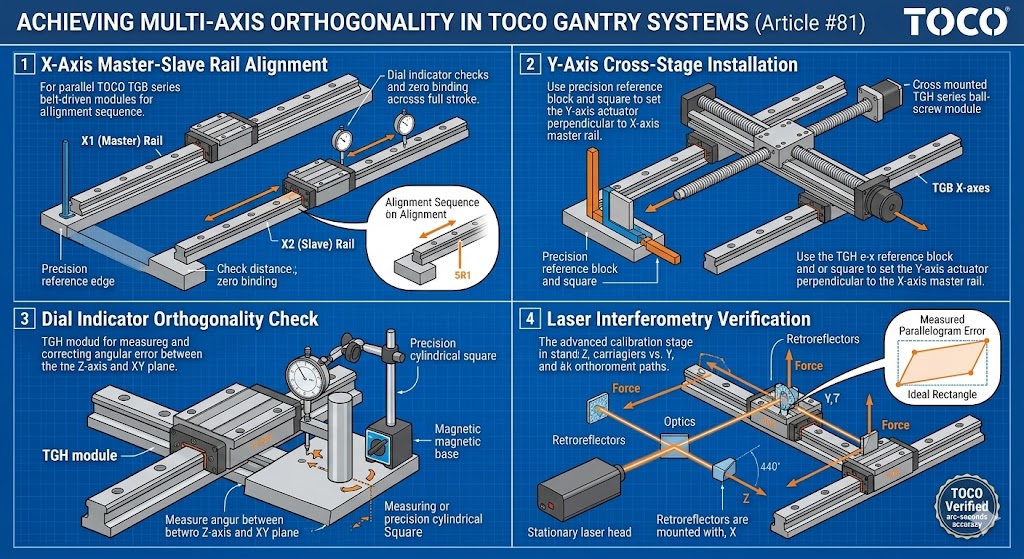
In high-precision motion, "Straightness" of a single rail is only half the battle. When building an XY or XYZ gantry system using TOCO TGB or TGH modules, the most difficult parameter to master is Orthogonality—ensuring that the X-axis and Y-axis are perfectly perpendicular (90.000-degree to one another.
1. The Cost of "Squareness" Errors
If your axes are off by even 0.01-degree, a square programmed to be 500mm x 500 mm will actually be a parallelogram. In CNC cutting, PCB assembly, or pick-and-place automation, this leads to components that don't fit and holes that don't align.
2. The Master-Slave Alignment Method
When installing parallel TOCO rails, we recommend the Master-Slave approach:
The Master Rail: This is the primary reference. It is bolted down and aligned to a precision-ground reference edge or laser line.
The Slave Rail: This rail is left slightly loose. The carriage is moved to the far end of the stroke to "find" the natural parallel position before final torquing. This prevents binding and ensures smooth travel across the entire stroke.
3. Verification with Laser Metrology
To verify Article #81-level precision, engineers use laser interferometers. By measuring the diagonal distance of a large rectangular move and comparing it to the theoretical hypotenuse 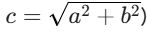 , we can detect angular errors as small as ±2 arc-seconds.
 English
 German
 French
 Russian
 Spanish
 Japanese
 Korean
 Khmer
 Portuguese
 Ukrainian
 Arabic
 Italian
 Afrikaans
 Albanian
 Armenian
 Azerbaijani
 Basque
 Belarusian
 Bulgarian
 Catalan
 Croatian
 Czech
 Danish
 Dutch
 Estonian
 Filipino
 Finnish
 Galician
 Georgian
 Greek
 Haitian Creole
 Hebrew
 Hindi
 Hungarian
 Icelandic
 Indonesian
 Irish
 Latvian
 Lithuanian
 Macedonian
 Malay
 Maltese
 Norwegian
 Persian
 Polish
 Romanian
 Serbian
 Slovak
 Slovenian
 Swahili
 Swedish
 Thai
 Turkish
 Urdu
 Vietnamese
 Welsh
 Yiddish

