

When a TOCO ball screw is subjected to a compressive (pushing) load, it acts like a structural column. If that load exceeds a certain threshold, the screw will suddenly bow and fail. This phenomenon is known as Buckling.
For engineers designing vertical Z-axes or heavy-duty pressing modules, calculating the "Column Strength" is non-negotiable.
1. The Physics: Euler’s Buckling Theory
Buckling is not a failure of the material's strength (the steel isn't "crushing"), but a failure of the shaft's geometry. Because ball screws are often long and relatively thin, they are prone to elastic instability.
The maximum permissible compressive load is determined by the screw's root diameter (dr), its unsupported length (L), and the End Fixity (how the ends are mounted).
2. The Formula: Permissible Compressive Load (Pp)
To calculate the safe operating load for a TOCO ball screw, we use the following formula:
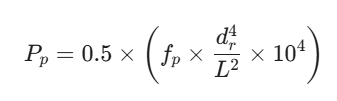
Where:
Pp: Permissible compressive load (N).
dr: Root diameter of the screw (mm).
L: Max unsupported length (mm).
fp: Factor based on the end-support arrangement.
0.5: A standard safety factor (representing a 2:1 safety margin).
3. The Power of Mounting (End Fixity Factors)
Just like with critical speed, how you bolt the screw into your machine changes its strength. Improving your mounting is often cheaper than buying a larger diameter screw.
| Mounting Arrangement | fp Factor | Relative Strength |
| Fixed - Free | 2.5 | Lowest (Avoid for high loads) |
| Supported - Supported | 10.2 | Standard |
| Fixed - Supported | 20.3 | High Strength |
| Fixed - Fixed | 40.6 | Highest (4x stronger than Supported-Supported) |
Pro Tip: By simply upgrading from a "Supported-Supported" to a "Fixed-Fixed" bearing arrangement, you can quadruple the load capacity of the same TOCO screw without increasing its size.
4. Tension vs. Compression: The Design Secret
If your application allows it, always design your system so the screw is in Tension (pulling) rather than Compression (pushing).
Compression: Limited by buckling (Column Strength).
Tension: Limited only by the tensile strength of the steel (much higher).
In vertical "hanging" loads, placing the fixed bearing at the top ensures the screw is stretched by the weight of the carriage, effectively eliminating the risk of buckling.
5. When to Oversize Your Screw
If your calculated load is nearing 50% of the buckling limit (Pp), TOCO recommends moving to the next diameter size. Real-world factors like shock loads, off-center loading, or misalignment can create "moment loads" that lower the actual buckling threshold below the theoretical math.
Conclusion
A ball screw is a precision power transmitter, but in compression, it is a vulnerable column.
By applying Euler's formula and selecting the highest possible End Fixity factor (fp), you can ensure your TOCO motion system handles heavy thrust loads without the risk of catastrophic deformation.

 English
 German
 French
 Russian
 Spanish
 Japanese
 Korean
 Khmer
 Portuguese
 Ukrainian
 Arabic
 Italian
 Afrikaans
 Albanian
 Armenian
 Azerbaijani
 Basque
 Belarusian
 Bulgarian
 Catalan
 Croatian
 Czech
 Danish
 Dutch
 Estonian
 Filipino
 Finnish
 Galician
 Georgian
 Greek
 Haitian Creole
 Hebrew
 Hindi
 Hungarian
 Icelandic
 Indonesian
 Irish
 Latvian
 Lithuanian
 Macedonian
 Malay
 Maltese
 Norwegian
 Persian
 Polish
 Romanian
 Serbian
 Slovak
 Slovenian
 Swahili
 Swedish
 Thai
 Turkish
 Urdu
 Vietnamese
 Welsh
 Yiddish

