

When selecting a TOCO ball screw or linear guide, you will encounter two primary numbers: Basic Static Load Rating (C0) and Basic Dynamic Load Rating (C).
While they look like simple weight limits, they represent two completely different physical phenomena. Understanding the difference—and the standards they are measured by—is the key to a 10-year machine life.
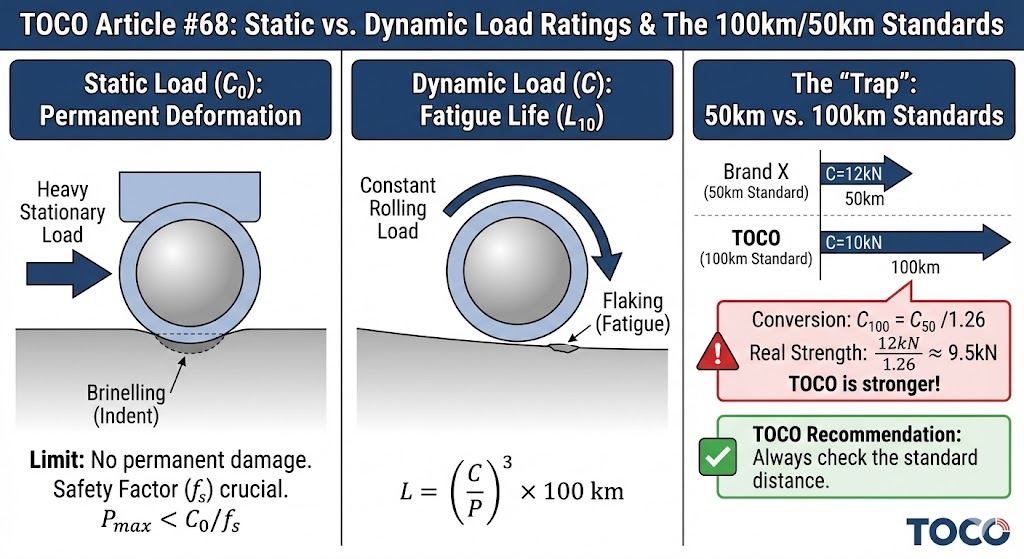
1. Basic Static Load Rating (C0): The "Brinelling" Limit
The static load rating is about permanent deformation.
Definition: It is the maximum load that can be applied to a bearing while it is stationary without causing a permanent "dent" in the race or the ball.
The Physics: If you exceed C0, the balls will create microscopic craters (called Brinelling) in the rail. When the carriage finally moves, it will vibrate and fail rapidly.
Design Rule: In applications with high shock loads or "E-stops," always ensure your peak load remains well below C0.
2. Basic Dynamic Load Rating (C): The "Fatigue" Limit
The dynamic load rating is about service life.
Definition: It is the constant load under which a group of identical bearings can run for a specific distance before the first sign of "flaking" (fatigue) appears.
The Math: Unlike the static rating, this is used in the L10 Life Equation:
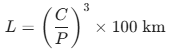
(Where P is the equivalent applied load).
3. The "100 km vs. 50 km" Trap
This is where many engineers make a critical mistake when comparing TOCO to other brands. There is no universal distance standard for the Dynamic Load Rating (C).
100 km Standard: Used by TOCO and most Japanese/European manufacturers.
50 km Standard: Used by many regional manufacturers to make their numbers look "stronger."
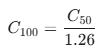
The Conversion: To compare a 50 km rated bearing to a TOCO 100 km rated bearing, you must apply a conversion factor. For ball-type bearings:
If you don't convert, you might mistakenly think a competitor's rail is stronger simply because they used a shorter "test track."
4. The Importance of the Safety Factor (fs)
Calculated loads are rarely the "real" loads. In the real world, we have vibration, misalignment, and uneven surfaces. TOCO recommends applying a Static Safety Factor (fs) based on the application:
| Operation Condition | Recommended fs |
| Normal Loading (Smooth) | 1.0 – 1.3 |
| With Impact or Vibration | 2.0 – 3.0 |
| High Precision / High Safety | 3.0+ |
Conclusion
A higher load rating on a datasheet doesn't always mean a better product.
By checking whether the rating is based on 50 km or 100 km and ensuring your peak loads stay within the Static (C0) limits, you can accurately predict the lifespan of your TOCO motion system and avoid the "surprise" of premature failure.
 English
 German
 French
 Russian
 Spanish
 Japanese
 Korean
 Khmer
 Portuguese
 Ukrainian
 Arabic
 Italian
 Afrikaans
 Albanian
 Armenian
 Azerbaijani
 Basque
 Belarusian
 Bulgarian
 Catalan
 Croatian
 Czech
 Danish
 Dutch
 Estonian
 Filipino
 Finnish
 Galician
 Georgian
 Greek
 Haitian Creole
 Hebrew
 Hindi
 Hungarian
 Icelandic
 Indonesian
 Irish
 Latvian
 Lithuanian
 Macedonian
 Malay
 Maltese
 Norwegian
 Persian
 Polish
 Romanian
 Serbian
 Slovak
 Slovenian
 Swahili
 Swedish
 Thai
 Turkish
 Urdu
 Vietnamese
 Welsh
 Yiddish