
When you program a TOCO linear module to move from Point A to Point B, you aren't just setting a speed; you are defining a "profile."
How the system reaches that speed and how it comes to a halt is the difference between a machine that lasts 10 years and one that needs a rebuild in 10 months.
The Enemy: "Jerk"
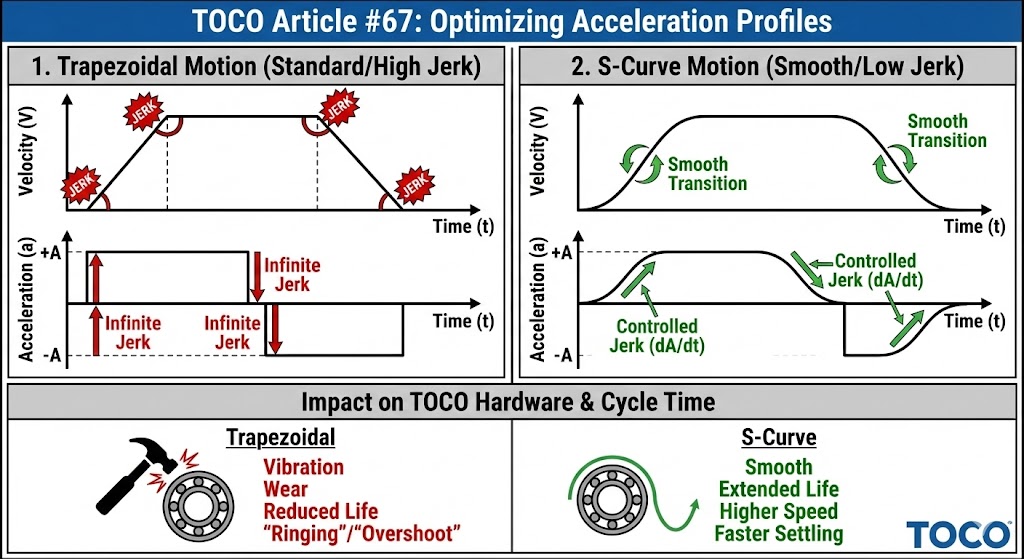
In physics, Jerk is the rate of change of acceleration  . High jerk means the acceleration changes instantly, creating a "hammer blow" effect on the ball bearings, couplings, and motor mounts.
This leads to vibration, audible noise, and premature wear on the TOCO ball screw or belt.
1. Trapezoidal Motion: The Simple Standard
The Trapezoidal profile is the most common in basic automation. It consists of three phases: constant acceleration, constant velocity, and constant deceleration.
The Problem: At the transition points (where acceleration starts or stops), the jerk is theoretically infinite.
Impact on Hardware: This sudden change causes the machine to "snap" into motion, leading to mechanical ringing (vibration) at the end of the move.
Best For: Simple transport where "settling time" doesn't matter and the load is light.
2. S-Curve Motion: The Precision Professional
An S-Curve profile rounds off the "corners" of the trapezoid. It gradually ramps the acceleration up and down.
The Benefit: By limiting the jerk, you eliminate the "snap." The motion feels fluid and "organic."
Impact on Hardware: TOCO components experience significantly less peak stress. This allows for higher top speeds because you aren't fighting the vibrations caused by the start of the move.
Best For: High-speed pick-and-place, CNC machining, and carrying delicate loads (like liquids or wafers).
Comparing the Profiles
| Feature | Trapezoidal Profile | S-Curve Profile |
| Complexity | Low (Easy to compute) | High (Requires more CPU) |
| Mechanical Stress | High (Instant acceleration) | Low (Smooth transitions) |
| Vibration/Noise | Higher "Ringing" | Near Silent |
| Cycle Time | Slower (due to settling) | Faster (reaches stability sooner) |
| Bearing Life | Standard | Extended (up to 20% longer) |
Why S-Curve is the "Secret" to Longevity
Imagine hitting a golf ball with a hammer (Trapezoidal) versus swinging a golf club (S-Curve). Both move the ball, but the hammer destroys itself over time.
For TOCO ball screws, the S-Curve ensures that the ball bearings "roll" into the load zone rather than being slammed into it.

By increasing Δ t at the start of the move, we keep J (Jerk) within safe limits for the mechanical assembly.
Conclusion
If your TOCO linear system sounds loud or vibrates when it stops, your hardware might be fine, but your motion profile is likely too aggressive.
Switching from a Trapezoidal to an S-Curve profile is one of the cheapest and most effective ways to increase your machine's accuracy and the service life of its components.
 English
 German
 French
 Russian
 Spanish
 Japanese
 Korean
 Khmer
 Portuguese
 Ukrainian
 Arabic
 Italian
 Afrikaans
 Albanian
 Armenian
 Azerbaijani
 Basque
 Belarusian
 Bulgarian
 Catalan
 Croatian
 Czech
 Danish
 Dutch
 Estonian
 Filipino
 Finnish
 Galician
 Georgian
 Greek
 Haitian Creole
 Hebrew
 Hindi
 Hungarian
 Icelandic
 Indonesian
 Irish
 Latvian
 Lithuanian
 Macedonian
 Malay
 Maltese
 Norwegian
 Persian
 Polish
 Romanian
 Serbian
 Slovak
 Slovenian
 Swahili
 Swedish
 Thai
 Turkish
 Urdu
 Vietnamese
 Welsh
 Yiddish