

Introduction: The Race for Speed and Precision
In the quest for the ultimate CNC machine or automation cell, engineers often face a critical crossroads: Should they use the tried-and-true Ball Screw Drive or the cutting-edge Linear Motor?
While ball screws have dominated the industry for decades, linear motors are gaining ground in high-speed, high-acceleration applications. This guide compares the two technologies to help you determine which "engine" should drive your linear motion.
1. What is a Linear Motor? (Motion Without Contact)
Imagine a standard rotary motor that has been "unrolled" and laid out flat.
The Setup: A series of permanent magnets are laid along the track (the "stator"), and a coil assembly (the "forcer") moves above them.
The Mechanism: There is no mechanical connection between the moving part and the stationary part. Motion is generated entirely by electromagnetic forces.
2. Ball Screw Drives: The Mechanical Powerhouse
As discussed in previous articles, ball screws use a rotating screw shaft to move a nut. It is a mechanical system involving physical contact and friction (albeit very low rolling friction).
The Setup: Motor → Coupling → Ball Screw → Nut.
The Strength: Massive mechanical advantage and the ability to hold position even when power is lost.
3. Head-to-Head Comparison
| Feature | Ball Screw Drive (TOCO) | Linear Motor |
| Max Speed | Moderate (~60-100 m/min) | Extreme (>300 m/min) |
| Acceleration | Good (Up to 1.5G) | Incredible (Up to 10G+) |
| Precision | High (Micrometer level) | Ultra-High (Sub-micron) |
| Load Capacity | Very High (Mechanical advantage) | Lower (Magnetic force limits) |
| Cost | Cost-Effective | Very Expensive |
| Maintenance | Greasing required | Zero (No contact/wear) |
| Heat Generation | Low | High (Coils generate significant heat) |
4. When to Choose a Ball Screw (The TOCO Specialty)
Despite the speed of linear motors, Ball Screws remain the industry standard for 80% of applications because:
Force Density: If you are milling heavy metal or lifting a heavy load, the mechanical "push" of a ball screw is far superior.
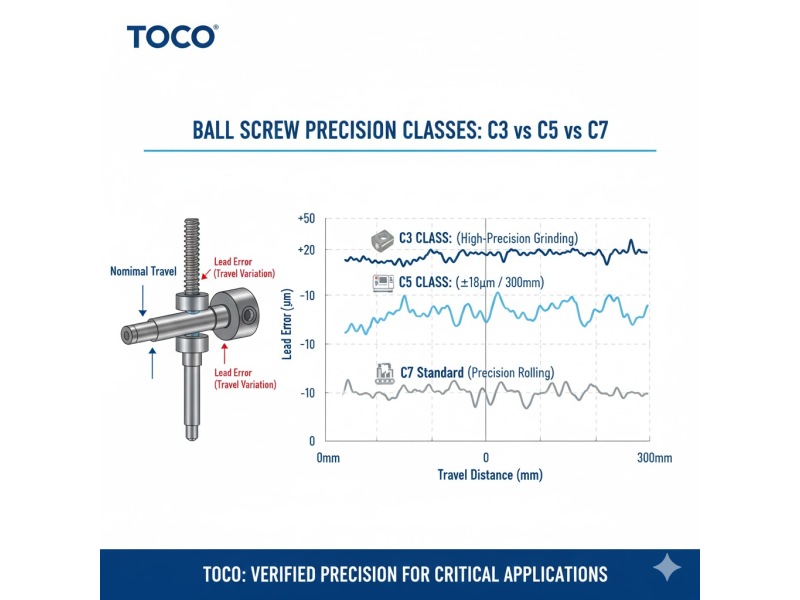
Cost vs. Performance: For most CNC and automation tasks, a C3 or C5 ball screw provides all the precision needed at a fraction of the cost of a linear motor system.
Safety: If power fails, a ball screw stays in place. A linear motor might "drop" or slide because there is no mechanical friction to hold it.
5. When to Choose a Linear Motor
You should consider the jump to linear motors only if:
Throughput is Everything: In semiconductor scanning or high-speed electronic assembly where every millisecond counts.
Zero Wear is Required: For machines that run 24/7 at extreme speeds where even a ball screw would eventually wear out.
Long Travels: For very long gantry systems (over 5 meters), ball screws can "whip" or vibrate, whereas linear motor tracks can be extended indefinitely.
Conclusion: Balancing Power and Innovation
Linear motors offer a glimpse into the future of motion, but the Ball Screw remains the reliable, powerful, and cost-effective heart of modern precision machining. At TOCO, we optimize our ball screws to push the limits of speed and accuracy, ensuring you get "near-linear motor" performance without the extreme price tag.
 English
 German
 French
 Russian
 Spanish
 Japanese
 Korean
 Khmer
Khmer Portuguese
 Ukrainian
 Arabic
 Italian
 Afrikaans
 Albanian
 Armenian
 Azerbaijani
 Basque
 Belarusian
 Bulgarian
 Catalan
 Croatian
 Czech
Czech Danish
 Dutch
Dutch Estonian
 Filipino
 Finnish
 Galician
 Georgian
 Greek
Greek Haitian Creole
 Hebrew
 Hindi
Hindi Hungarian
 Icelandic
 Indonesian
 Irish
Irish Latvian
 Lithuanian
 Macedonian
 Malay
Malay Maltese
 Norwegian
 Persian
 Polish
 Romanian
 Serbian
 Slovak
 Slovenian
 Swahili
 Swedish
 Thai
Thai Turkish
 Urdu
Urdu Vietnamese
 Welsh
Welsh Yiddish