

Introduction: The Silent Killer of Accuracy
Have you ever commanded a CNC machine to move 10mm forward and 10mm back, only to find it didn't return to the exact same spot? That tiny "gap" or "slop" is called Backlash.
In high-precision manufacturing, backlash isn't just a minor annoyance—it leads to poor surface finishes, broken tools, and parts that fail inspection. Understanding why it happens and how to eliminate it is essential for any high-performance motion system.
1. What Exactly is Backlash?
Backlash is the amount of lost motion (play) between the screw and the nut. When the screw shaft changes direction, there is a momentary "dead zone" where the screw turns, but the nut does not move because it is crossing a tiny internal gap.
Why it occurs:
Mechanical Clearance: Space required for the rolling elements to move without seizing.
Wear and Tear: Over time, friction can erode the raceways, widening the gap.
Elastic Deformation: Under heavy loads, components can compress slightly, mimicking the effect of backlash.
2. How to Eliminate Backlash: The Power of Preload
The most effective way to prevent backlash in a ball screw is through Preloading. Preloading involves creating an internal force within the nut assembly so that the rolling elements are always in contact with both sides of the screw thread.
Common Preloading Methods:
Oversized Ball Preload (Single Nut): Inserting balls that are slightly larger than the space between the nut and screw. This is cost-effective and saves space.
Double Nut Preload: Using two nuts separated by a spacer or spring. This allows for very high preload levels and maximum rigidity.
Lead Offset Preload: A sophisticated method where the "pitch" of the thread inside a single nut is slightly shifted to create tension.
3. The Benefits of Zero-Backlash Systems
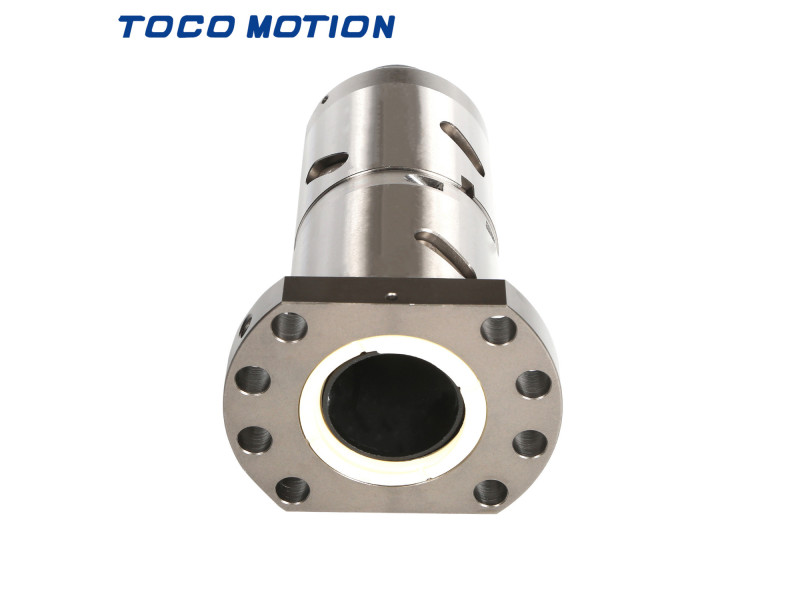
When you use a TOCO preloaded ball screw to eliminate backlash, your machine gains several immediate advantages:
High Repeatability: The machine returns to the exact same coordinate every time, regardless of the direction of approach.
Better Surface Finish: Eliminates "chatter" during milling, resulting in smooth, mirror-like finishes on metal parts.
Improved Circularity: Essential for milling perfect circles; without backlash control, circles often turn into "ovals."
Increased System Rigidity: Preloading "stiffens" the assembly, allowing it to resist external cutting forces.
4. When is a Little Backlash Okay?
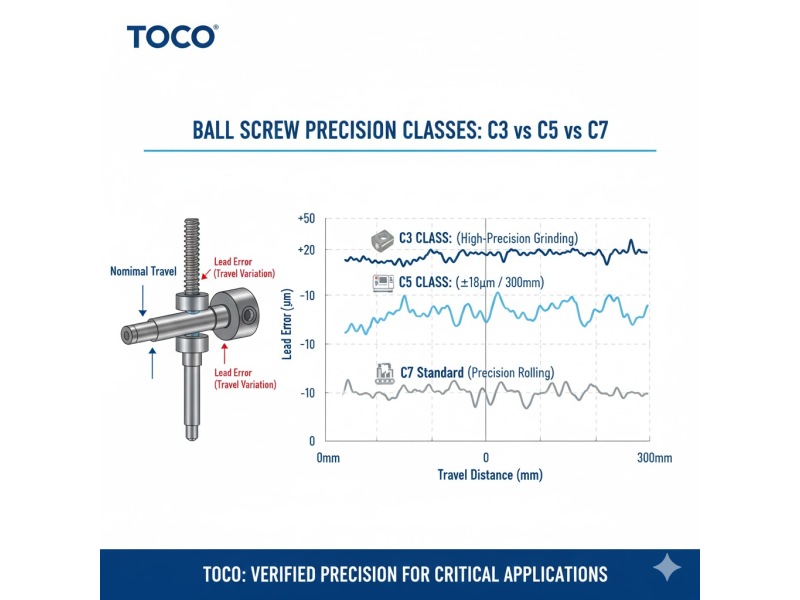
Not every application needs a zero-backlash C3 ground screw.
Manual Transport: For simple conveyor belts or height adjustments, a standard C7 rolled ball screw with a small amount of clearance is often more cost-effective.
Vertical Axes: In some vertical setups, gravity keeps the nut pushed against one side of the thread, naturally "canceling" the backlash.
The TOCO Expertise: Precision Calibration
At TOCO, we help engineers find the "Sweet Spot." Too much preload increases friction and heat; too little allows for backlash. Our technical team calculates the optimal preload for your specific load and speed requirements, ensuring your assembly achieves maximum life and zero-slop performance.
 English
 German
 French
 Russian
 Spanish
 Japanese
 Korean
 Khmer
Khmer Portuguese
 Ukrainian
 Arabic
 Italian
 Afrikaans
 Albanian
 Armenian
 Azerbaijani
 Basque
 Belarusian
 Bulgarian
 Catalan
 Croatian
 Czech
Czech Danish
 Dutch
Dutch Estonian
 Filipino
 Finnish
 Galician
 Georgian
 Greek
Greek Haitian Creole
 Hebrew
 Hindi
Hindi Hungarian
 Icelandic
 Indonesian
 Irish
Irish Latvian
 Lithuanian
 Macedonian
 Malay
Malay Maltese
 Norwegian
 Persian
 Polish
 Romanian
 Serbian
 Slovak
 Slovenian
 Swahili
 Swedish
 Thai
Thai Turkish
 Urdu
Urdu Vietnamese
 Welsh
Welsh Yiddish