

Introduction: Precision Requires Care
A high-precision ball screw or linear guide is a masterpiece of engineering, but its performance is not "set and forget." In industrial environments—where dust, metal shavings, and heat are constant—proper maintenance is the difference between a machine that lasts 10 years and one that fails in six months.
To protect your investment and maintain the accuracy of your CNC or automation system, follow these essential maintenance protocols.
1. Lubrication: The Lifeblood of Motion
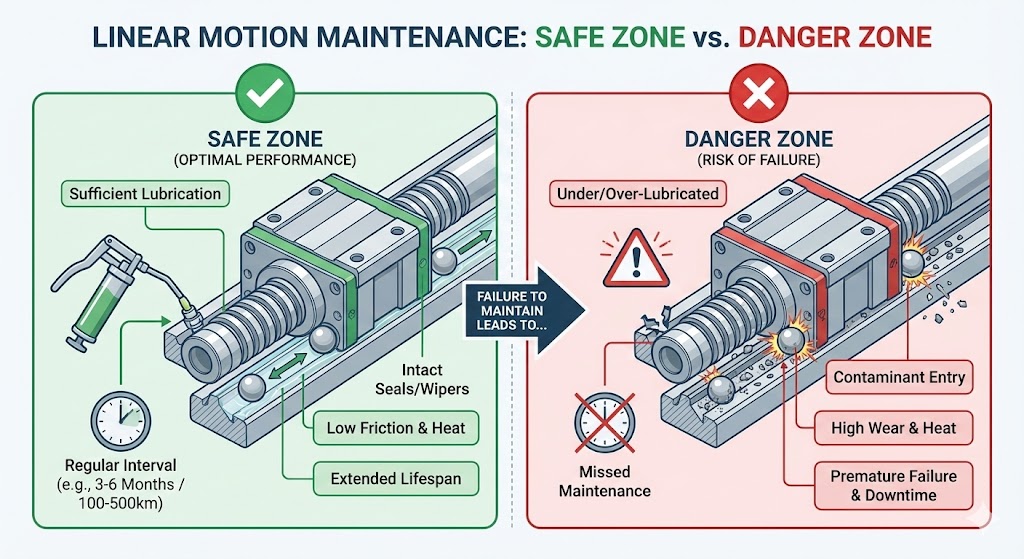
Lubrication is the single most important factor in the lifespan of a linear motion system. It creates a thin film between the rolling elements and the raceways, preventing metal-to-metal contact.
Grease vs. Oil: Most TOCO linear guides and ball screws are designed for Lithium-soap-based grease. Oil is typically reserved for high-speed applications or systems with automatic lubrication pumps.
The "Goldilocks" Rule: Too little lubrication causes friction and wear; too much can increase heat and attract more dust.
Lubrication Intervals: As a general rule, re-lubricate every 100km to 500km of travel, or every 3 to 6 months, depending on the environment.
2. Contamination Control: Keeping the Path Clear
Contaminants like sawdust, metal chips, or coolant spray are the "assassins" of precision components. Once grit enters the ball nut or carriage, it acts like sandpaper, grinding down the precision surfaces.
Check the Seals/Wipers: Ensure the end seals on your linear carriages and ball nuts are intact. If they are torn, replace them immediately.
Use Bellows or Covers: In extremely dirty environments (like stone cutting or wood routing), use telescopic covers or accordion bellows to shield the rails and screws entirely.
Wipe Down Rails: Periodically wipe the rails with a clean, lint-free cloth and apply a light coat of anti-rust oil.
3. Regular Inspection: Spotting Trouble Early
Don't wait for a breakdown. Perform a visual and "auditory" inspection monthly:
Listen for Noise: A "crunching" or grinding sound usually means contamination has entered the raceways. A high-pitched squeak usually means a lack of lubrication.
Feel for Vibration: Run the axis at a slow speed. Any "jitter" or rough spots indicate potential pitting on the rail or balls.
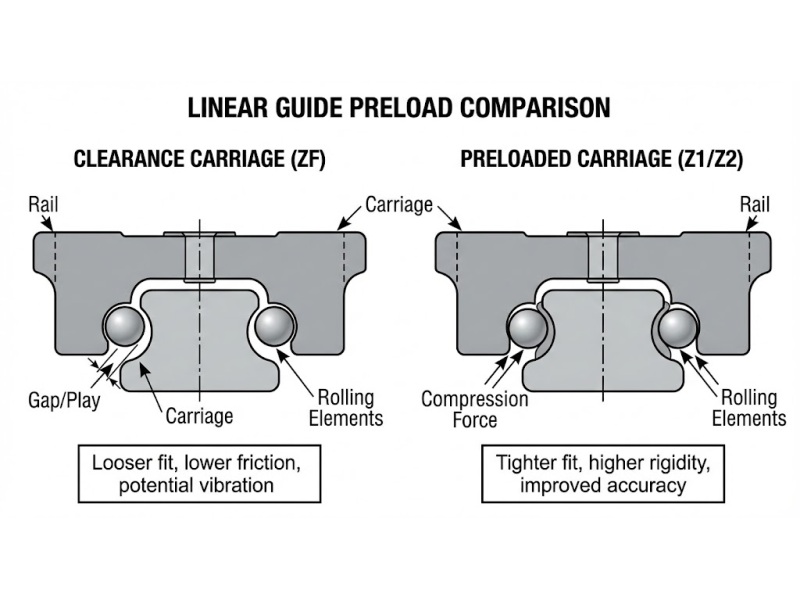
Monitor Temperature: If a ball nut or carriage feels hot to the touch (over 50℃) during normal operation, it may be over-preloaded or severely under-lubricated.
4. Proper Alignment and Installation
Maintenance starts at installation. If the rails are not perfectly parallel or the ball screw is slightly misaligned with the motor, it creates "internal loading."
Symptoms: One side of the carriage wearing out faster than the other.
Solution: Use a dial indicator to ensure parallelism within the tolerances specified in the TOCO technical manual.
The TOCO Durability Advantage
While maintenance is key, the quality of the base material matters most. TOCO uses high-carbon chromium bearing steel and advanced heat-treatment processes to ensure our components have a high surface hardness (HRC 58-62). This inherent durability makes our parts more resilient to occasional maintenance lapses than lower-quality alternatives.
 English
 German
 French
 Russian
 Spanish
 Japanese
 Korean
 Khmer
Khmer Portuguese
 Ukrainian
 Arabic
 Italian
 Afrikaans
 Albanian
 Armenian
 Azerbaijani
 Basque
 Belarusian
 Bulgarian
 Catalan
 Croatian
 Czech
Czech Danish
 Dutch
Dutch Estonian
 Filipino
 Finnish
 Galician
 Georgian
 Greek
Greek Haitian Creole
 Hebrew
 Hindi
Hindi Hungarian
 Icelandic
 Indonesian
 Irish
Irish Latvian
 Lithuanian
 Macedonian
 Malay
Malay Maltese
 Norwegian
 Persian
 Polish
 Romanian
 Serbian
 Slovak
 Slovenian
 Swahili
 Swedish
 Thai
Thai Turkish
 Urdu
Urdu Vietnamese
 Welsh
Welsh Yiddish