

Introduction: Beyond the Spreadsheet
In the past, calculating the lifespan of a linear system involved manual formulas and "best-guess" safety factors.
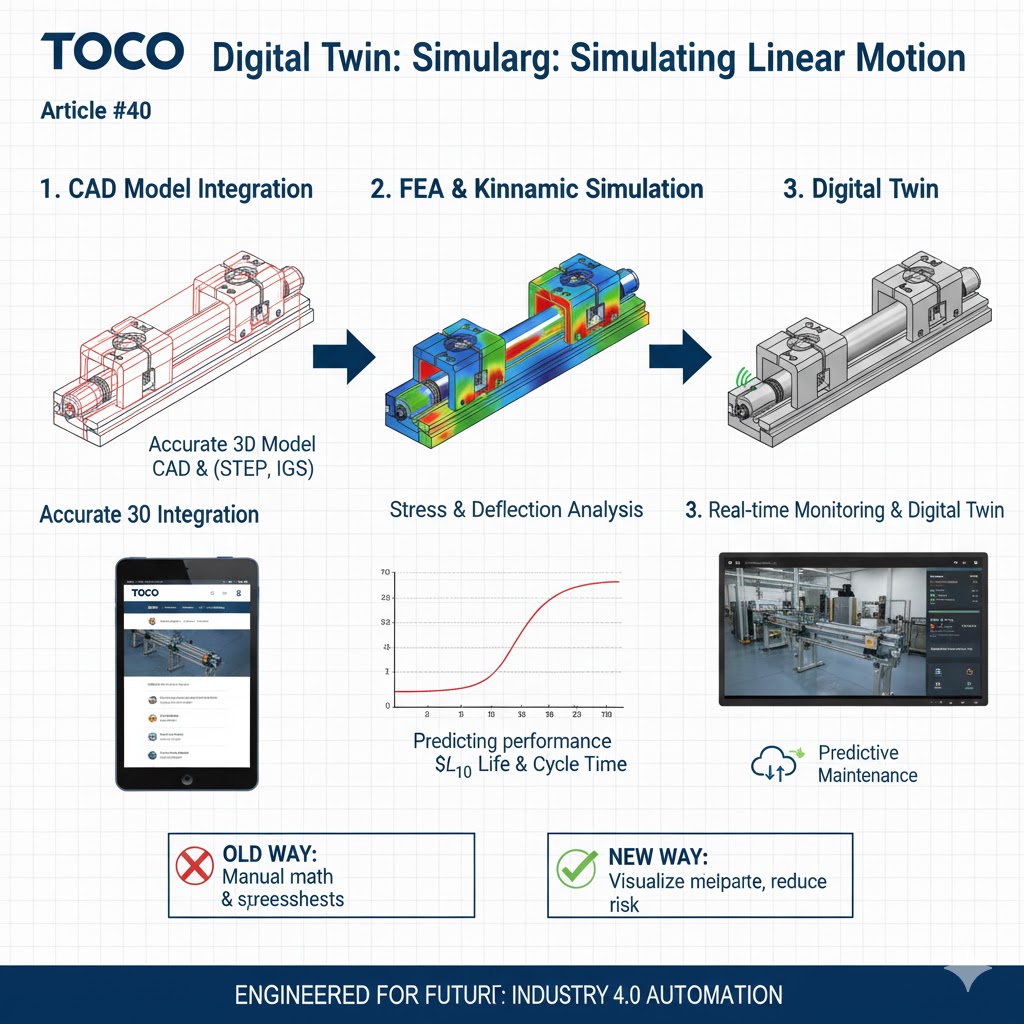
Today, TOCO supports the shift toward Digital Twins—virtual replicas of physical systems that allow engineers to simulate real-world stresses, thermal expansion, and wear in a risk-free environment.
1. Integrating TOCO CAD Models
The foundation of a Digital Twin is an accurate 3D model.
Native Formats: TOCO provides STEP, IGES, and SolidWorks files for all components.
Accuracy Matters: Our models include the precise internal geometry of raceways and ball diameters, which is crucial for Interference Checking (ensuring parts don't crash into each other during complex movements).
2. Finite Element Analysis (FEA)
FEA allows you to see "inside" the metal. By applying virtual loads to a TOCO rail in a software environment, engineers can visualize:
Stress Concentrations: Identifying exactly where the rail or carriage might fail under an extreme load.
Deflection Mapping: Predicting how much a rail will "sag" or twist under high-speed cornering.
Optimization: FEA helps determine if you can use a smaller, lighter rail without sacrificing safety, reducing the overall cost of the machine.
3. Kinematic Simulation: Predicting Travel Life
By linking the Digital Twin to motion profiles (acceleration, velocity, and dwell times), software can calculate the L10 Life Expectancy more accurately than manual math.(Load calculator pls refer to Engineering Design Tools)
Variable Loads: If your robot picks up a 5kg weight, moves it, and drops it, the load changes mid-cycle. Simulation accounts for this fluctuating fatigue.
Cycle Time Optimization: You can "overclock" the virtual motor to see at what point the ball screw reaches its critical speed or thermal limit.
4. Thermal Expansion Simulation
In high-precision machining, even a 1°C rise in temperature can cause a ball screw to expand by several microns, throwing off the accuracy of the part.
Predictive Compensation: Digital twins simulate the friction-generated heat of the TOCO nut.
Cooling Design: Engineers use this data to decide if they need external cooling or if "pre-tensioning" the screw will be enough to offset the expansion.
5. The Future: Predictive Maintenance (IIoT)
The Digital Twin doesn't die once the machine is built. By connecting sensors on the physical machine to the digital model:
Vibration Analysis: The twin compares real-time vibration data against "healthy" baseline models.
Failure Warning: The system can predict that a TOCO carriage needs lubrication or replacement weeks before a breakdown actually occurs.
 English
 German
 French
 Russian
 Spanish
 Japanese
 Korean
 Khmer
Khmer Portuguese
 Ukrainian
 Arabic
 Italian
 Afrikaans
 Albanian
 Armenian
 Azerbaijani
 Basque
 Belarusian
 Bulgarian
 Catalan
 Croatian
 Czech
Czech Danish
 Dutch
Dutch Estonian
 Filipino
 Finnish
 Galician
 Georgian
 Greek
Greek Haitian Creole
 Hebrew
 Hindi
Hindi Hungarian
 Icelandic
 Indonesian
 Irish
Irish Latvian
 Lithuanian
 Macedonian
 Malay
Malay Maltese
 Norwegian
 Persian
 Polish
 Romanian
 Serbian
 Slovak
 Slovenian
 Swahili
 Swedish
 Thai
Thai Turkish
 Urdu
Urdu Vietnamese
 Welsh
Welsh Yiddish