

When designing a high-precision stage using TOCO ball screws, the mechanical hardware is only as good as the system’s ability to "see" where it is.
In the world of motion control, we often hear about "Resolution," but resolution is not the same as accuracy. This article clarifies the gap between Micro-stepping (Open-Loop) and Servo Encoding (Closed-Loop).
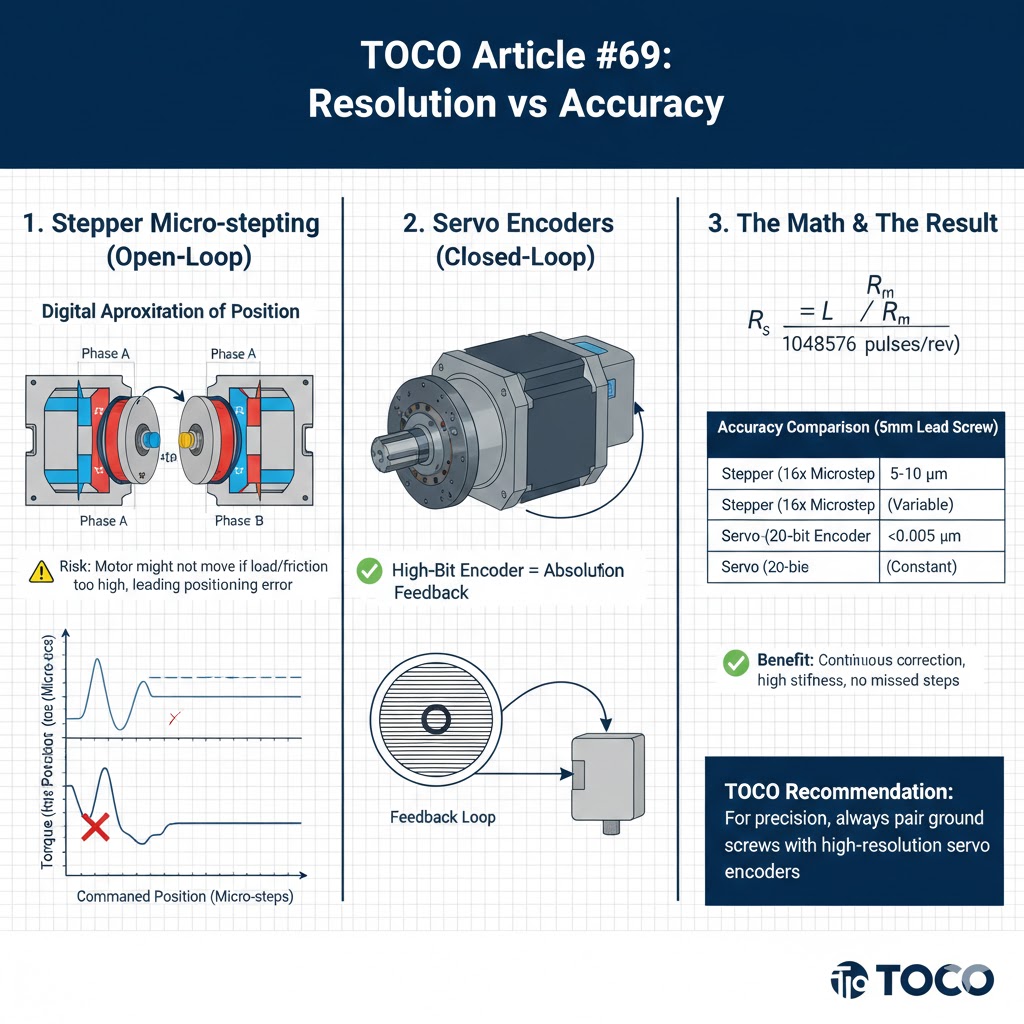
1. Stepper Micro-stepping: The Digital Approximation
A standard stepper motor has 200 "full steps" per revolution (1.8º per step). To get smoother motion, drivers use Micro-stepping to divide those 200 steps into thousands of tiny increments (e.g., 25,600 steps/rev).
The Reality: Micro-stepping is an electrical balance between two motor phases. While the driver commands a micro-step, the motor may not actually move if the friction in the TOCO guide rails or the load inertia is higher than the "incremental torque" of that tiny step.
The Risk: You might have a "resolution" of 1 micron on paper, but an "accuracy" of only 10 microns because the motor is "stretching" between steps without actually moving.
2. Servo Encoders: The Absolute Truth
A Servo motor doesn't guess; it knows. It uses an Encoder—a physical disk with thousands of etched lines—to report exactly where the shaft is.
17-bit vs. 24-bit: Modern TOCO-compatible servos use high-bit encoders.
A 20-bit encoder has
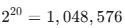 pulses per revolution.
The Advantage: If the motor is 1 micron off, the encoder sees it immediately, and the controller pushes harder to correct it. This is Closed-Loop Control.
3. The Math of Resolution
To find your system's resolution (Rs), you must combine the motor's resolution (Rm) with the lead of your TOCO ball screw (L):

Comparison Example (5mm Lead Screw)
| Motor Type | Commanded Resolution | Real-World Precision |
| Stepper (16x Microstep) | 3,200 steps/rev | ≈ 5-10 μm (Variable) |
| Servo (20-bit Encoder) | 1,048,576 pulses/rev | 0.005 μm (Constant) |
Why High Resolution Matters for TOCO Hardware
Even if you don't need "nanometer" precision, high-resolution feedback is vital for:
Smoothness: High-resolution servos produce much less vibration, extending the life of TOCO ball nuts.
Stiffness: A high-bit encoder allows the motor to "hold" its position more rigidly against external forces.
Settling Time: Better feedback means the system stops oscillating faster, increasing your machine's throughput.
Conclusion
Micro-stepping is a great way to make a stepper motor run quietly, but it is not a substitute for the high-resolution feedback of a servo.
For applications requiring repeatable, micron-level accuracy, the combination of a TOCO Ground Ball Screw and a High-Bit Servo is the only way to ensure that where you command the machine to go is where it actually is.
 English
 German
 French
 Russian
 Spanish
 Japanese
 Korean
 Khmer
 Portuguese
 Ukrainian
 Arabic
 Italian
 Afrikaans
 Albanian
 Armenian
 Azerbaijani
 Basque
 Belarusian
 Bulgarian
 Catalan
 Croatian
 Czech
 Danish
 Dutch
 Estonian
 Filipino
 Finnish
 Galician
 Georgian
 Greek
 Haitian Creole
 Hebrew
 Hindi
 Hungarian
 Icelandic
 Indonesian
 Irish
 Latvian
 Lithuanian
 Macedonian
 Malay
 Maltese
 Norwegian
 Persian
 Polish
 Romanian
 Serbian
 Slovak
 Slovenian
 Swahili
 Swedish
 Thai
 Turkish
 Urdu
 Vietnamese
 Welsh
 Yiddish